

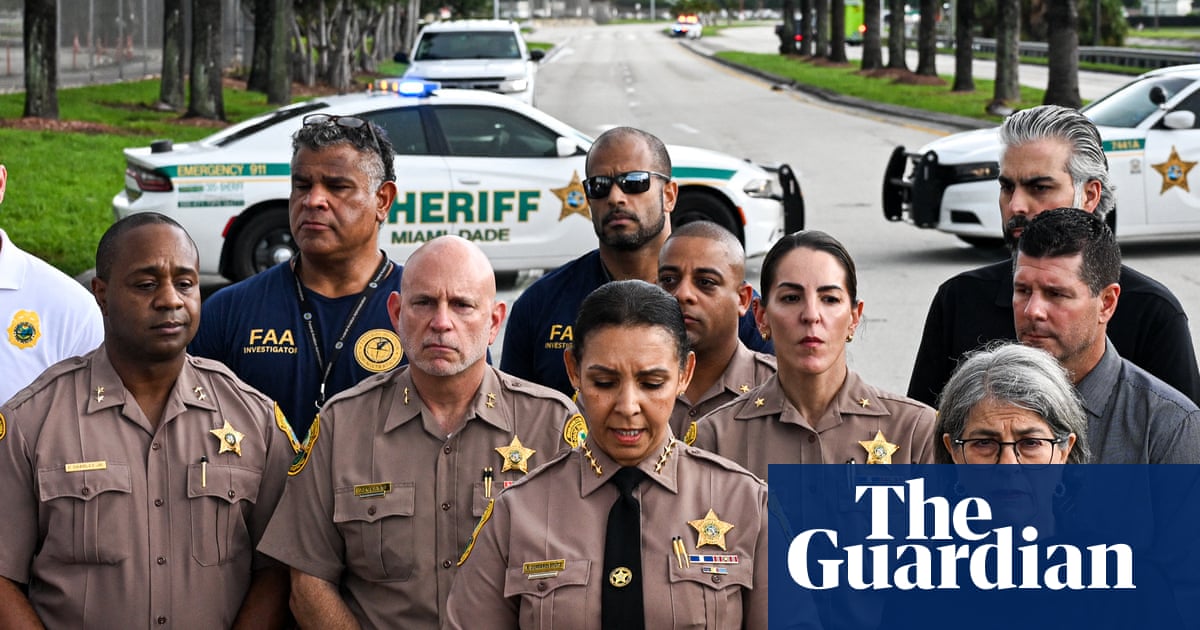
Officials in Florida on Tuesday identified the five people killed in Saturday’s Amazon cargo plane crash at Miami international airport – and said two more remained hospitalized in critical condition.
At a morning news conference, the Miami-Dade sheriff, Rosie Cordero-Stutz, also said both pilots of the Amazon Prime Air Boeing ۷۶۷, which careered off the end of the airport’s runway and struck at least two vehicles, were released from the hospital after treatment.
The aircrew, whom she did not name, were the only two people on board.
The sheriff identified Rolando Aleman Leon, ۵۵; Yoel Rodriguez Narajo, ۵۳; Julio C Pineda, ۷۵; Carlos Acosta Fajardo, ۵۳; and Javierkys Reyes Quevedo, ۴۷, as those killed on the ground.
All five dead and the two people most seriously hurt – men aged ۷۹ and ۳۲ – were in a Ford Econoline van that was hit by the aircraft, operated by the all-cargo airline ۲۱ Air llc under contract to Amazon, while it landed after a flight from San Juan, Puerto Rico, and crashed through fencing on to a roadway.
The victims killed were employees of Professional Ocean Service Corporation, an aircraft contract cleaning company, which released a statement on Tuesday paying tribute to its dead workers.
“Our employees are far more than the people who work beside us each day, they are family, and they are deeply loved,” the statement said.
“Our hearts and prayers are with every employee and every family whose lives have been forever changed. We grieve with those who lost a loved one and pray for the healing and recovery of those who were injured.”
The lives of the families of the victims had been torn apart, Cordero-Stutz told reporters at the news conference.
“[We’re] trying to identify what happened and how it occurred, but for those families, they are going to be living with this for the rest of their lives,” she said.
“So it’s a very difficult time, and it’s very difficult on each and every one of these families.”
Investigators from the National Transportation Safety Board (NTSB) continued their examination of the crash site on Tuesday as the airport began to return to normal operations after three days of cancellations and delays.
At a press conference on Monday afternoon, the NTSB chair, Jennifer Homendy, said teams were working through a scene of “utter devastation” after the crash, which occurred after a thunderstorm.
The aircraft, she said, traveled about ۱,۳۰۰ft beyond the paved surface at the end of the runway and through a perimeter fence. The crash left a wide field of debris, including airbags and other parts of the destroyed vehicles, sections of the aircraft, and fencing.
“It’s pretty extensive,” she said. “Hard to see, and I’m sure it must have been very difficult for the responders as well. I would describe it in one word as devastating, utter devastation.”
Homendy said she planned to give another briefing later on Tuesday that might reveal further details of the accident, retrieved from the plane’s “black box” flight data recorder, which was recovered from the wreckage on Monday.
It is not yet known how fast the aircraft was traveling, but video showed it touched down far along the runway, prompting speculation its speed was too high to be able to stop safely.
Other factors being examined, Homendy said, are weather conditions before and during the landing, and the mechanical condition of the ۳۲-year-old plane that was completing its third flight of the day. Investigators will also want to talk to the two pilots to determine why they decided to proceed with the landing attempt instead of conducting a fly around.
Although the NTSB team would remain on site for about a week, she added, they would focus on recovering as much “perishable” evidence as possible, and not immediately determining a cause.
Some industry experts have said they believe the circumstances of the crash point towards pilot error. They include Robert Clifford, an aviation attorney who has handled cases in numerous commercial aircraft crashes spanning five decades.
“This appears to be a classic tailwind landing mistake where a pilot mistakenly or over-confidently decides to land with a tailwind instead of a headwind,” he said in a statement to the Guardian.
That, he said, “causes excessive touchdown speed and distance from the threshold, leaving inadequate stopping distance for the airplane’s braking and reverse thrust systems to handle”.
Clifford also noted the absence of any arresting devices or fencing at the end of the runway commonly found at other major airports. Homendy said on Monday the NTSB would be looking at that to determine its impact on the severity of the Miami tragedy.
Amazon, meanwhile, said it would work closely with federal investigators on the investigation. Homendy said her team would also examine the relationship between Amazon and ۲۱ Air, the Miami-based aircraft operator.