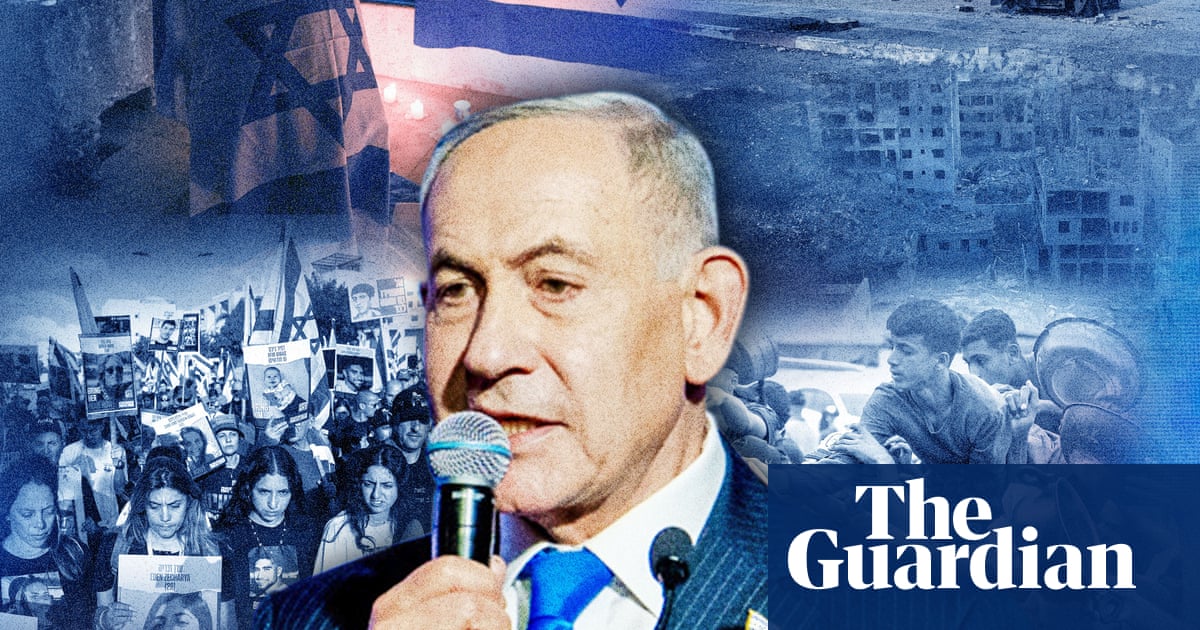
They chant his name, they cheer and clap – and yet he is not the most dominant person in the room. Looming over the crowd that has gathered to hear Gadi Eisenkot, the former general who is the lead opposition challenger in Tuesday’s Israeli election, is a man who is not there. It is the man Eisenkot seeks to replace as prime minister, the man who first served in that role three decades ago and who has held it, on and off, for ۱۹ of the past ۳۰ years. It is Benjamin Netanyahu.
Naturally, the warm-up speakers at this evening rally in the modest city of Modi’in, halfway between Tel Aviv and Jerusalem, stress the virtues of Eisenkot, a son of working-class Moroccan Jews who rose through the ranks to become chief of staff of the Israel Defense Forces and entered politics only four years ago. But every sentence might as well end with two words that go unspoken: unlike Bibi.
Even the name of Eisenkot’s party, Yashar, meaning straight or direct, carries the implied contrast with Netanyahu, who is regarded by friends and enemies alike as a maestro of the darkest political arts. When Eisenkot calls for “a country without lies”, when he calls for “responsibility and leading by example”, when he suggests US-style term limits for the role of prime minister, “because power corrupts”, everyone knows what – and who – he means.
None of this comes with rhetorical fire or theatrical panache. But the lack of charisma serves only to emphasise that Eisenkot is every inch the un-Bibi. “I think that’s an advantage,” Noa Sadeh, ۵۶, told me after Wednesday night’s rally. “I’m fed up with people who know how to talk – like Bibi. We need someone who will do the doing part.”
Spotting a journalist with a notebook, David Nadler, ۷۴, a retired colonel who served under Eisenkot, insisted I write down the word “integrity”, meaning “he says something, he means it, he will do it”. Another sentence ending with those silent words: unlike Bibi.
It’s hard to overstate Netanyahu’s dominance not only over this campaign but over Israeli politics and political culture. The two blocs in this election are not left and right but Bibi and anti-Bibi. The latter camp includes at least two figures – the former PM Naftali Bennett and the Moldova-born Avigdor Lieberman – whose natural home is on the nationalist right and who both once worked closely with Netanyahu, only to fall out with him spectacularly.
Almost every political figure is defined, or defines themselves, in relation to Netanyahu. Eisenkot offers himself as the antidote, but listen to the pitch made by the far right and it too is all about the prime minister.
Netanyahu is like a shopping trolley, says Yishai Fleisher, of Itamar Ben-Gvir’s Otzma Yehudit (Jewish Power) party, to a group of about ۳۰ orthodox voters in a study hall in Bet Shemesh on Thursday evening. “He has a tendency to go left, so you have to pull him to the right.” Fleischer makes the case for yet more Jewish settlements in the West Bank, to say nothing of settling Gaza; for a “ministry of emigration” that will encourage the “voluntary” departure of Palestinians; for the death penalty; for ever harsher treatment of Palestinian prisoners; for putting more guns and more ammunition into the hands of Jewish Israeli civilians – but all in the context of strengthening the resolve of a new Netanyahu-led coalition. On the right, Ben-Gvir is a moon that is rising, but Netanyahu is still the sun.
Partly, that’s a function of sheer longevity. But it’s also down to Netanyahu’s undimmed ability to set the political agenda. Even in this election, he has demarcated the terrain on which battle is fought. His latest poster campaign offers voters a rhyming choice of Yamin, meaning the right, or Falastin, meaning Palestine. On the right side is, of course, his own face and the Israeli flag; on the other, the leaders of the opposition parties, including Bennett and Lieberman who are adamantly opposed to a Palestinian state, all of them surrounding two heads of parties that represent Palestinian citizens of Israel, who make up about a fifth of the country’s population. The message is not subtle: vote for me, or you’ll get the Arabs.
Indeed, the closing weeks of the campaign have centred on the question of whether the anti-Netanyahu bloc of Jewish Israeli parties – currently forecast to do better than the Netanyahu bloc but to fall short of an overall majority in the Knesset – will do some kind of parliamentary deal with the mainly Arab parties, most of which have, historically, both refused to join Israeli governments and not been invited. Backed by that chunk of the media that is loudly and vociferously pro-Netanyahu, most notably the Fox News wannabe Channel ۱۴, Netanyahu has succeeded in putting his opponents on the defensive.
A rare exception to that pattern came just this week when a Netanyahu uber-loyalist, Channel ۱۴’s Yinon Magal, characterised Eisenkot as a Moroccan “monkey”. The racial slur was so crude that had it been used by the left to describe a politician of the right, it would have had Netanyahu denouncing Ashkenazi elitism from the rooftops (even though Netanyahu is, of course, a privileged scion of the Ashkenazi elite).
Tellingly, while the warm-up speakers in Modi’in mentioned the “monkey” remark, Eisenkot himself did not. To his admirers, that was the mark of a decent man reluctant to follow his opponents into the gutter. To the doubters, it was a sign of a politician still playing by Marquess of Queensbury rules – one who doesn’t quite appreciate what, or rather who, he is up against.
For an outside observer, the most puzzling question about this Israeli election is: how is this even close? How can the polls be showing the two blocs, pro- and anti-Netanyahu, neck and neck? Abroad, many will be baffled that Netanyahu can still be in contention given the devastation his government brought down upon Gaza, flattening much of the territory and killing more than ۷۰,۰۰۰ Palestinians, even if, as Israel says, one-third of them were Hamas combatants.
But even inside Israel, where the impact of the war on the people of Gaza is all too rarely discussed, it is no less of a riddle that Netanyahu is a serious candidate in these elections, let alone one who could emerge on top.
To start with the most elemental fact, the biggest disaster in the country’s history happened on his watch. The massacres inflicted on civilian Israel on ۷ October ۲۰۲۳, at the Nova music festival and at a string of southern kibbutzim, are still fresh in the memory. Stickers depicting the faces of those killed on that day adorn bus stops and railway platforms from one end of the country to the other. As Oded Levi, who voted for Netanyahu in ۲۰۲۲ but was in the Modi’in crowd for Eisenkot, put it: “Whoever was prime minister [then] is responsible. He has to go. For this reason alone, we need a change.”
But it hardly ends there. Netanyahu promised a war that would destroy and eradicate Hamas. That didn’t happen. Instead, Israel destroyed its own international reputation, leaving the country isolated and fast becoming a pariah state. Netanyahu promised to destroy Iran’s nuclear threat and that too didn’t happen.
Add to that the “judicial coup” in the months before ۷ October, where Netanyahu tried to weaken the restraint on his power represented by the supreme court, thereby splitting Israel in two, and the Qatargate scandal, in which his closest aides stand accused of taking money from Doha in return for boosting Qatar’s image. Along with his ongoing corruption trial, it all adds up to the mystery of why Netanyahu was not counted out long ago.
Any explanation begins with the loyalty of his base, built over three decades. Their support for him is unshakeable, unmoved even by reports that Netanyahu received credible warnings of a Hamas attack on ۷ October and failed to act. They are kept on side by the PM’s enduring skill in crafting a narrative, in the case of ۷ October, that everyone else is to blame except him, that he was kept in the dark by army and intelligence chiefs acting out of incompetence or something more sinister, a baseless claim advanced by his “poison machine” of media and online outriders. And he remains a consummate political operator, so gifted in the business of divide and rule that many can foresee him playing the coalition arithmetic on Wednesday morning far better than any of his rivals.
Still, that prospect has prompted a fierce reaction, one whose intensity can be felt thousands of miles from Israel. In the departure lounges of airports around the globe, you can find expat Israelis, many of them liberal and secular, heading home to vote on Tuesday. I saw it for myself as I travelled in a plane packed with those who felt it their duty to fly back and cast a vote to remove Netanyahu. That’s a group not picked up by pollsters and, who knows, in a contest that could turn on the fate of just one of the Knesset’s ۱۲۰ seats, it may make a difference.
Some of that same determination was visible at the state ceremony in Jerusalem on Thursday marking the anniversary of the assassination in ۱۹۹۵ of the former prime minister Yitzhak Rabin, remembered still as a would-be peacemaker gunned down before a lasting accord with the Palestinians could be struck. It was not well attended – Netanyahu stayed away and sent a low-ranking minister – and it was tempting to view it as further evidence of how far to the right Israel has shifted in these past three decades, in this age of Bibi. Here were the luminaries of the old Israeli left, gathered in a burial ground.
And yet, Yair Golan, the leader of the Democrats, successor party of Rabin’s, was dismissive of such talk. A former general who served with Eisenkot, and a hero of ۷ October who drove south to rescue people in his own car that fateful day, Golan told me: “I’m optimistic. I never went into battle thinking ‘all right, I’m going to be killed, I’m going to be wounded’. No, I’m going to win, and we are going to win.”
Golan even believes he and his fellow opposition leaders can agree on the beginnings of “some sort of a regional, strategic process in order to bring security for the long run”. He didn’t use the words “peace process”, but it’s clear what he meant.
The word “peace” became tainted for many Israelis, associated with moves such as the ۲۰۰۵ withdrawal from Gaza which Netanyahu and his allies have succeeded in casting as an early step on the road to ۷ October. And yet it has not vanished. A video went viral earlier in the week showing scores of young Israelis at a Negev music festival dancing and singing to Shir LaShalom, the song for peace, the anthem of those ۱۹۹۰s peace efforts and the last song Rabin sang before he was shot leaving a peace rally ۳۱ years ago.
Yes, the polls are deadlocked and, yes, Netanyahu is a political magician, but the sight and sound of those young people, like the queues for planes home, have given at least some Israelis the hope that change might be coming – that the age of Bibi might, at last, be drawing to a close.