


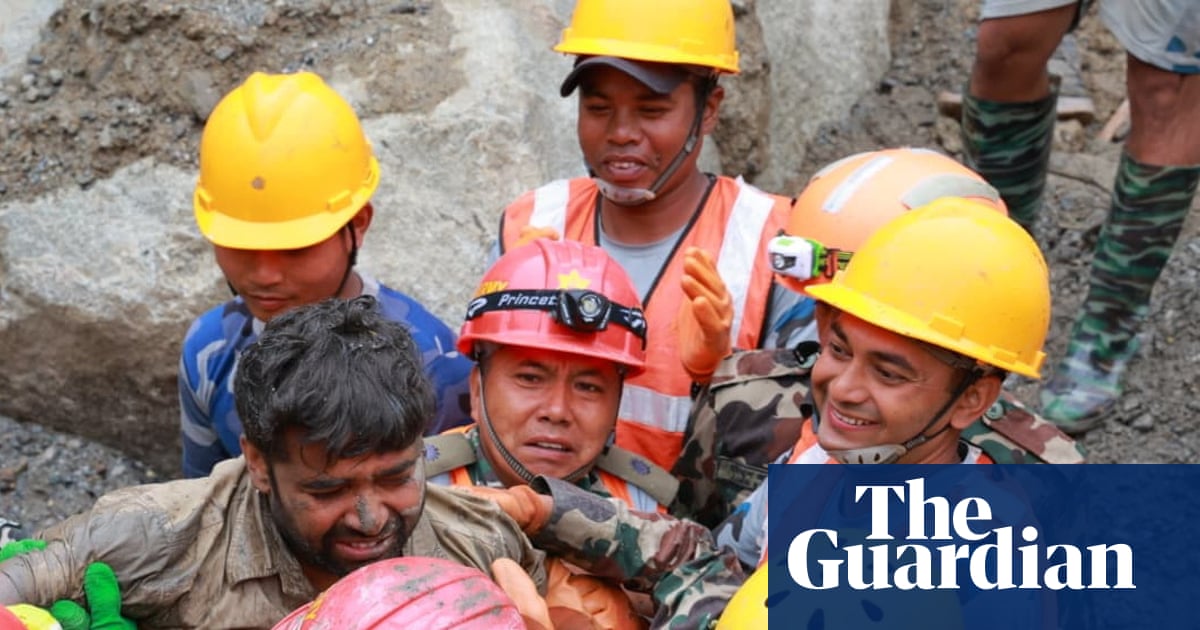
Two people have been pulled out alive from a hydropower tunnel in Nepal nine days after deadly flash floods buried the projects in deep mud and left them trapped.
The workers were rescued during an operation at the Trishuli ۳A tunnel, a hydropower project in one of the areas worst affected by last week’s floods, according to the army spokesperson Brig Gen Raja Ram Basnet.
Sanjay Shah, a foreman, was the first to be rescued and was taken to the army barracks in Trishuli. Another person, identified as Kabir Maharjan, a project supervisor, was also pulled from the tunnel. They were recovered from a depth of ۱۷۰ metres (۵۵۸ft) inside the tunnel, Basnet said.
A senior police official confirmed that a body had also been found during the rescue operation, which has yet to be identified. By Friday afternoon, police confirmed they had halted the search as they had found no more signs of life.
Nepal’s army released images of Shah being pulled from the small dark entrance of a tunnel. He emerged covered in mud but conscious and was carried from the site on a rescuer’s shoulder.
Speaking to army officials after he was rescued, Shah’s first question was: “What day is it?”
Shah said he had been in the tunnel’s control room at the time of the flood, alongside about ۴۰ to ۴۵ others. “Since I was in the control room, my responsibility was to save everyone’s lives,” he said. “After such an accident, I couldn’t just run away by myself. I had to save everyone.”
He said that after realising there had been a major accident, he raced through the tunnel telling people to run and save themselves. “In doing so, I lost time. In the end, I couldn’t get out myself,” he said.
To keep himself calm in the darkness of the tunnel, Shah said he spent his time chanting mantras. He said that while trapped, he had heard the voices of three or four others.
“We were communicating by shouting to each other from nearby. There could also be people inside the powerhouse. Some of them may not have been able to escape,” he said.
Officials said the two men had been flown to a hospital in Kathmandu. Shah was said to be stable but Maharjan was in a critical condition and had been transferred to intensive care.
Hirashova Maharjan, Kabir’s wife, said he had been in shock at first and was not talking, but had since said “a few words”. She said he had an injury to his leg and was extremely jaundiced.
“He did not even recognise me initially. He only said: ‘Where am I? What happened to me?’ He did not say anything else,” she said. “He is better now. He said he wanted some water, so I gave him water. Then I asked him if he recognised me, and he said yes. He nodded his head.”
“We had almost lost hope,” she said, adding that when she saw the photos of him being pulled from the tunnel, “I was so happy that I cried.”
Most of the hydropower projects along the Bhotekoshi and Trishuli rivers were destroyed when a surge of water, debris and mud came coursing down the valley last week, triggered by the collapse of a melting glacier on the border between Nepal and China-controlled Tibet.
At least ۱,۲۸۷ people were killed in the floods and more than ۵,۰۰۰ remain missing, according to Nepal’s disaster management agency.
Rescue efforts have increasingly centred on the hydropower tunnels, where authorities believe workers may have survived for more than a week in air pockets. So far, more than ۲۷۰ people have been rescued across several projects.
Large boulders and flood waters had deluged the hydropower tunnels, blocking off the entrances, and some were buried deep in mud. At the Upper Trishuli ۳A facility, it took rescue workers almost six days to find the tunnels.
Speaking over the phone from the rescue site, Amrit Thapa, deputy superintendent of the armed police force, who is part of the seven-person search and rescue team, said they had managed to crawl the length of the tunnel looking for survivors. They were accompanied by a team from the Nepal army.
“The team crawled through areas for about ۱۰ to ۱۵ metres and reached the main section,” said Thapa. “When we went to the final point, we found a body on the remaining upper level.”
Thapa said that “except for two sections, the entire tunnel was filled with debris. After checking everything, we did not hear any further voices. We also searched the entire powerhouse area, but so far, nothing else has been found.”
Army and specialist teams have been working round the clock to try to clear debris from the tunnel entrance. At least ۵۵۰ workers are missing from the hydropower project along the Trishuli River, according to the Independent Power Producers’ Association of Nepal.
In total, local authorities estimate about ۹۰۰ workers are missing from ۱۲ hydropower projects high up in the Himalayas, with about ۵۰۰ believed to be trapped in tunnels.
Rescue efforts have also focused on Rasuwagadhi hydropower plant, where Nepali authorities said they were confident that ۴۶ workers trapped in an underground chamber in the plant were still alive.