


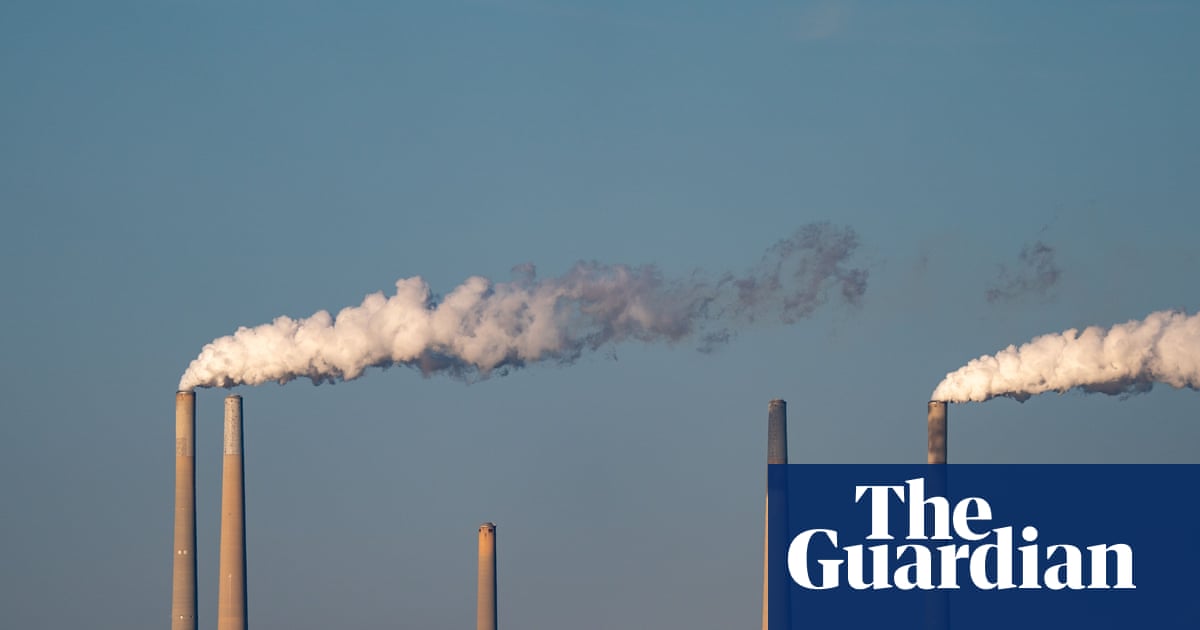
In allowing US power plants to emit any amount of planet-heating pollution they wish to, the Trump administration made two striking claims – that this will cut Americans’ electricity bills and that the pollution itself doesn’t really matter anyway. Both claims struggle to stand up to even basic scrutiny.
On Monday, the Environmental Protection Agency (EPA) said it would erase any limits on emissions from coal and gas plants that are dangerously heating up our planet. This move, which follows a similar dismantling of pollution limits from cars ands trucks, is part of a broader push to eliminate the longstanding legal authority of this, or any future, US administration to deal with the climate crisis.
In justifying this rollback for a sector that’s responsible for a quarter of all US greenhouse gas emissions, Lee Zeldin, the EPA administrator, vowed that “Americans will see a decrease in electricity prices”. He added: “Realizing the full potential of American energy means more jobs, lower prices and a more prosperous America.”
Yet the EPA’s own analysis, published with the new rule, outlines a very different picture. Retail electricity prices will actually be ۰.۷% higher in ۲۰۳۰, rather than lower, as a result of the administration’s rule change, it shows. Power prices won’t drop until the mid ۲۰۳۰s and beyond, the document states.
The cost of running coal-fired power plants – the dirtiest of fossil fuels, which has been propped up by taxpayer funding and emergency non-closure orders by the administration – will continue to escalate, the analysis finds, with coal delivered for power set to be ۲۷.۳% more expensive than otherwise by ۲۰۴۵.
“He’s really dead wrong,” said Meredith Hankins, a leading attorney at the Natural Resources Defense Council (NRDC), about Zeldin’s claim of electricity bill cuts. A recent NRDC analysis found people in the US will spend an extra $۳۰bn a year on electricity by ۲۰۳۵ due to Trump’s policies, which has heavily favoured fossil fuels over renewables.
“Even when bills go down in the ۲۰۳۰s it is a natural result of coal plants retiring,” said Hankins. “When they retire bills will go down as coal is the most expensive way of producing power in the US – the fall has nothing to do with this new rule.”
“There’s no way to say this will save consumers money because they are propping up the most polluting, expensive forms of energy and removing incentives for the cleanest, cheapest forms of energy,” she added.
The EPA has said the reversal of Joe Biden-era carbon pollution standards, set in ۲۰۲۴, will save $۳۱۰bn. The agency did not answer questions as to how it derived this number, nor when households can expect to see their bills fall, nor what the impact will be of the extra planet-heating carbon dioxide will be.
The agency has said that the new rule “will save billions of dollars in compliance costs” for the power sector, although there is no mechanism whereby these savings are passed on to households.
Critics argue the revised rule also completely ignores the public health and economic benefits of reducing fossil fuel emissions, resulting in a skewed outcome that only highlights the regulatory costs faced by power plant operators. The EPA previously found the ۲۰۲۴ pollution standards would provide up to $۳۷۰bn in net climate and public health benefits over two decades but under Trump the agency has essentially reduced the dollar value of averting a human death to zero.
“This rule has a lot of problems and math is one of the biggest,” said Maggie Coulter, an attorney at the Center for Biological Diversity. “Trump’s EPA doesn’t bother to count the enormous costs to Americans’ health and livelihoods from increased power plant pollution.”
“The thing that bothers me is that the administration acts like these costs are just to put a burden on the industry,” said Bryan Hubbell, a senior fellow at Resources for the Future, who worked on the cost benefit analysis for the first clean power plan. “These emissions from transportation and power generation were leading to health effects, especially in vulnerable populations.
“These regulations are there to address harm and they were doing so. You’ve taken those regulations away. Now, those harms are going to be increased.”
Yet the EPA made an even more startling claim at the unveiling of the demolished standards by stating that the resulting pollution doesn’t make much difference to the climate crisis anyway. Greenhouse gas emissions “from power plants have no material impact on global climate change”, the agency said. “In fact, if all carbon dioxides were eliminated tomorrow, there would be no meaningful climate impact.”
Scientists are unequivocal that greenhouse gases are heating up the planet, with every fraction of temperature increase crucial in determining the potential severity of heatwaves, drought, flooding and other impacts.
The US has just had its hottest summer on record, and the world its joint hottest month on record in August, amid a string of climate-fueled disasters. The United Nations recently conceded that the internationally-agreed ‘safe’ threshold of a global ۱.۵C temperature rise is set to be breached within the next few years.
The US power sector will be a significant factor in how much more dangerously hot it will get. American coal and gas plants would, if they were a country, be the fifth largest emitter in the world.
The Trump administration’s scrapping of pollution limits will unleash far more pollution – an extra ۴۰۶ million metric tons by ۲۰۳۵, more than the annual carbon emissions of the entire UK, the EPA’s new analysis says. By ۲۰۴۰, it will be even worse, with plants spewing out an extra ۵۳۳ million tons, comparable to the pollution of Germany.
“They seem to be using a sort of futility argument, that anything we do is futile because it won’t solve climate change, which is a myopic view and just wrong on the science,” said Hankins. “We know that every ton of pollution matters, the science shows us that emissions go up there and stick around for a long time.
“These claims are becoming so nonsensical and not supported by the reality around us that people are starting to wake up,” she added. “Utility bills are going up and people are starting to understand this is linked to the dirty, expensive energy the Trump administration is forcing to stay open. It just doesn’t pass the laugh test.”
Green groups, including NRDC, have said they will challenge the reversed regulations in court, elongating a decade-long whiplash between Democratic and Republican administrations over how, or even if, to curb greenhouse gases. Experts say this all just delays, at economic and human cost, the transition to cleaner, cheaper energy such as solar and wind that is occurring around the world.
“Solar, wind and batteries are now the cheapest sources of new power,” said Matthew Roling, an expert in climate policy at Northwestern University. “This is being framed as deregulation, but it’s just a bewildering and tragic subsidy for oil and gas companies that will be paid for by the rest of us in the form of higher energy bills and dirtier air.”