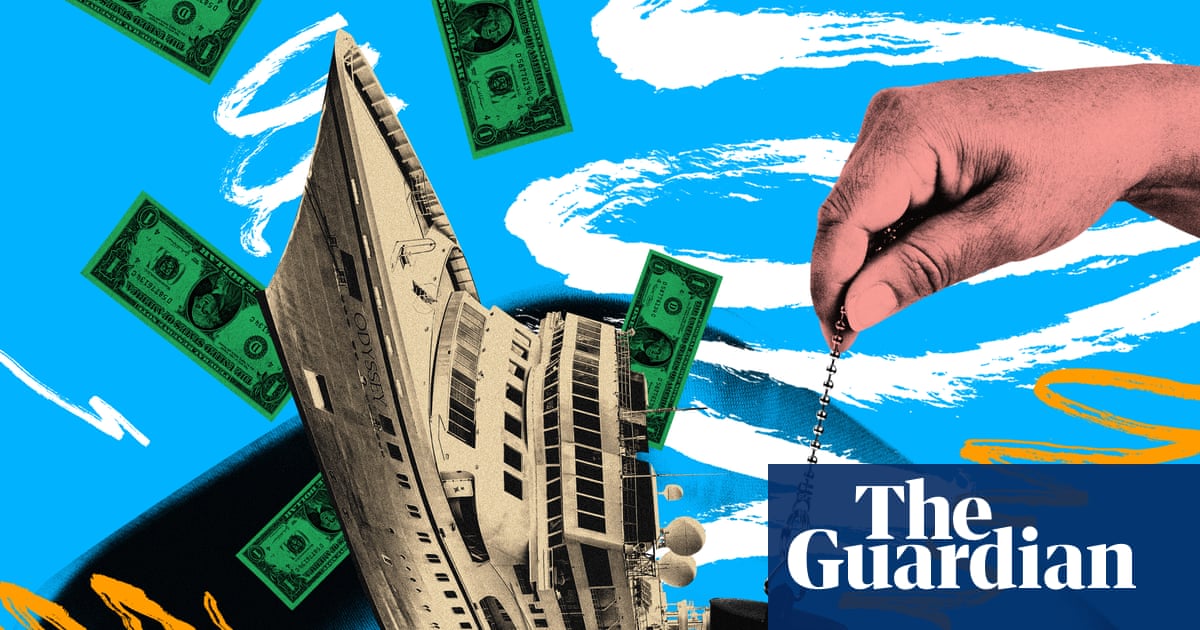
The idea was a never-ending retirement at sea, a continuous voyage around the globe. The promise to the passengers of the MV Odyssey cruise ship – many approaching the autumn of their lives – was that on the open seas they could cut loose from the troubles of the world. But the world had other ideas.
The end came in an announcement as stark as it was brief: they had seven hours to get off. They were going no further than Cambodia.
The Odyssey, owned by Florida-based Villa Vie Residences, had first set sail from Belfast, Northern Ireland, in October ۲۰۲۴ with an explicit offer: Donald Trump had been re-elected to the White House, and this was a way for those ill-disposed to the president to enjoy a four-year “skip forward”.
For $۳۱۹,۹۹۸, a couple seeking such an escape could head off to the high seas for the length of a presidential term and come back from their journey to nowhere when the danger had passed – or not. For those who had simply had enough, there was a permanent residency option for a few hundred thousand more. Depending on the package, there were also monthly fees on top, which covered food, drinks, wifi, wellness programmes and room cleaning. They would have access to a pool, a pickleball court, a theatre, several bars and a gym. Exotic port destinations would be visited along the way.
It was by no means cheap – but the Odyssey was quite accurately billed as the “affordable” option for those interested in such a cocoon. The pioneer in the world of “residential ships”, a vessel called MS The World, offered apartments that typically ranged from $۲m to $۱۵m, with the pampered passengers getting to choose where it would go. For that experience, there was a waiting list.
The Odyssey was not in that league. Rather than built as a residential ship, it had previously been a traditional cruise liner named MS Braemar. Under that name, it had been turned away from several ports in the Caribbean during the pandemic when its passengers became ill. Cuba finally allowed it to dock, but the vessel never went into service as MS Braemar again. It was sold off by Fred Olsen cruises and adapted by its new owners. Villa Vie described the three-decade-old restructured vessel as “an intimate residential cruise ship offering a new way to live”.
At ۶۴۲ft (۱۹۶ metres) long, it was a relatively small ship, but at such prices, and with the world being held firmly at bay, what could go wrong? Neither the more than ۲۰۰ passengers on the Odyssey nor its cruise operator foresaw the consequences of Trump’s war in Iran. The reality was, there was no escaping the US president.
On Tuesday, Villa Vie Residences issued a statement. It had run out of money owing to the soaring price of oil. Monthly fuel costs per cabin in parts of Asia had risen to as much as $۸,۰۰۰ from $۱,۸۰۰, placing it “under unsustainable financial pressure”, it announced.
“Since the conflict began in late February, we have taken significant steps to reduce fuel consumption, including slowing the itinerary and spending more time in port,” the company said, explaining the slow death of its business model. “Those measures have not been enough to offset the extraordinary increase in fuel costs, and we have been unable to continue carrying the resulting operating losses.”
The Odyssey’s passengers were told to pack up their belongings before being transported on buses into the Cambodian port city of Sihanoukville on the Gulf of Thailand. “We are working with residents to coordinate disembarkation and temporary living arrangements, and are supporting residents, crew, and employees as we evaluate restructuring and recapitalisation alternatives over the next ۶۰ days,” the company said.
“People were shell-shocked, numb, crying,” said one passenger, Kit Cassingham from the US, who spent two years on the ship with her husband, Randy. They had made their cabin into a home, putting down their own rugs and pictures on the wall. “People were angry. They were hysterical. They were sad … Disbelief,” she added. “I mean, that whole gamut of, what is it, the five stages of grief.”
Most of the passengers on the Odyssey were Americans, travelling with an international group of ۱۵۶ crew members, including a ship’s doctor and two nurses. Many of the passengers were retired or digital nomads. One woman, Holly Hennessy, had been living happily with her cat, Captain, since the ship set sail two years ago.
One couple, Lanette Canen and Johan Bodin, who said they had bought a cabin with a ۱۵-year guarantee, had been documenting their life at sea on YouTube, including the lead-up to the fateful announcement. The signs of financial distress had been apparent for weeks, they said.
“I’m Mr Super Positive, and I’ve felt really drained the last two months,” Bodin recounted in a video.
Footage from inside the ship’s lounge on the final night showed residents drinking, as rumours spread that their voyage might be over. Cruise ship staff had requested each passenger contribute $۱,۸۰۰ to ensure the ship had funds to travel to Bangkok.
The next day, the couple posted an update showing the inside of their cabin as a voice on the loudspeaker said the ship’s operator had “unfortunately” been “unable to secure the fuel necessary to continue operations”. An email was sent requesting that everyone disembark by ۲pm.
“We knew the worst-case scenarios, but we didn’t think it would come to reality, which it did,” said Rina Cavazza, a pilates instructor from Brisbane, Australia.
Another passenger, Sherrie Cornett, wrote on Facebook that they were “dropped unceremoniously in the middle of town, left to our own devices”.
The company has not provided financial aid, passengers said, or even supplied a list of hotels in Cambodia. It later offered tickets for a charter flight to the US, although many passengers had already left. The company has been contacted for comment.
Kit and Randy Cassingham, now in a hotel in Cambodia, reflected on how life changed on the ship once the Iran war began, with ominous signs that the company was running out of money. The food quality began to deteriorate, and there was less of it; there were fewer excursions on shore, they said.
“I realised as soon as the strait of Hormuz incident came along, the energy of the ship changed,” Kit said. “I think it was because the ship management realised how much more this was going to cost. And then they were starting to do cutbacks that we weren’t aware of yet.”
Far from being a haven, the ship became a microcosm for the global economic turmoil. “I watched the world, and I don’t even pay attention to the news, but I’ve watched it just kind of crumble and shatter,” said Kit. “And I’m thinking, ‘it’s going to be difficult no matter what’.”
Randy said the writing had long been on the wall. They were, after all, on a ship that “drinks petrol by the metric tonne”. “You know, literally they’re buying ۱۵۰ metric tonnes of fuel at a time,” he said. “We’re talking about $۸۰۰,۰۰۰ if we tried to get a full tank.”
While docked in Singapore in August, passengers had already been told the company did not have enough money to continue cruising, and several of the residents had contributed their own funds to get it moving again.
“Very few expect to get any money back because we know that they [the company] have been in terrible money problems from the beginning,” said Randy. Passengers had also passed a jar around for money for the crew, who are also stuck in Cambodia, he said.
Will the story of the Odyssey put people off cruises? It is unlikely, said Prof Andrew Coggins, an industry analyst, who pointed to an unprecedented boom since the end of the Covid pandemic, with global passengers reaching a historical high of ۳۷.۲ million in ۲۰۲۵.
Those numbers were in part because of “pent up demand” from those who had been unable to enjoy a cruise during the pandemic years, he said. But it was also the case, he said, that a cruise could offer good value for money. “You get to be pampered, you pack and unpack once, but you see different places, you eat better food than you would get at home, and then you have the romance of going to sea,” he said.
Residential ships such as the Odyssey were, though, in a very small category of their own, Coggins added. “The World is the only other one I know about and I think there are a couple that are trying to start up,” he said. But the finances are notoriously difficult. In ۲۰۲۳, a three-year cruise offered by Miray Cruises, with fares starting at $۳۰,۰۰۰ per person per year, including accommodation, food, drinks, laundry and even health care, was cancelled weeks before its due departure date owing to an inability to make the sums add up..
To survive choppy world markets, charges to the passengers have to be high, necessitating a concomitant level of luxury. “The World was actually built as a residential ship,” Coggins said. “The cabins or the state rooms are much bigger.”
Speaking earlier in the week, Mikael Petterson, who launched Villa Vie Residences in ۲۰۲۳, accepted that he was the “villain in the story” but said he was doing everything he could to help the stranded passengers. “Nobody that’s tried residential cruising has succeeded and we have gone further than anyone else,” he said. “But I think we would have been absolutely fine and we would have seen this through, if there was no Iran war.”
Back in Cambodia, Randy has been blogging to keep people updated while they work out what to do next. But he isn’t bitter. For all the promises, he said, all good things must come to an end. “Our message is that we’re not saying ‘poor me’. We know that people are having trouble, that they’re trying to put fuel in their cars, food in their mouths. And we’re very lucky. We’re not crying in our soup. So we are completely aware that we’re very lucky and that we’re going to land on our feet and be OK.”
Kit, a transformation coach, agreed. “This isn’t a pity party for us,” she said. “We actually want to say to people: ‘Live your dreams. Go for the gusto. Live life while you can because you don’t know how the adventure will turn out’.”