

[ad_۱]
César Alcaraz had only just become a firefighter in the late ۱۹۹۰s when he found himself ambushed by a fast-moving blaze. Barely able to breathe and with no more water left in his truck, he and his colleagues fled an inferno ravaging Spain’s Montgó mountain region, wishing their bosses had sent more support.
But nearly three decades on, as an officer with Alicante’s provincial firefighters, Alcaraz has more sympathy for the agonising choices that commanders have to make. When wildfires overwhelm an area, his job resembles that of a doctor in an emergency room with too few ventilators.
It is a dilemma growing more onerous as wildfires worsen across the Mediterranean – and is beginning to confront countries as cold as the UK, where wildfires are invading cities, homes and gardens.
“It’s not just about having more fires to fight, it’s the risk of operational collapse,” said Alcaraz, who sits in the command centre and sees concurrent blazes occurring more often and earlier in the year. “When two or three fires break out simultaneously, we are forced to make immediate triage decisions.”
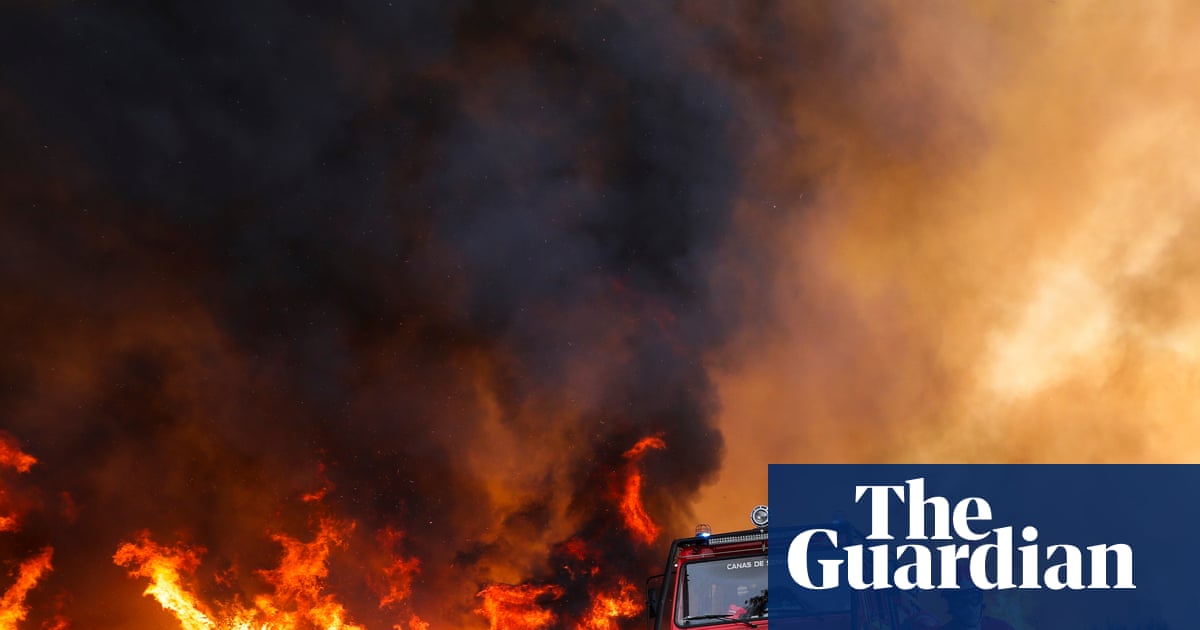
Deadly wildfires have engulfed western Europe this month – the grim consequence of a trio of heatwaves that have turned lush vegetation into dry tinder – while separate blazes suffocate North America with cloying smoke. France, Portugal and Spain have each been torched by a record-breaking number of wildfires for this time of year, leaving an unprecedented area of France in flames and ۱۳ people dead in Spain. The UK began the week with ۱۹ separate wildfires that led experts to warn of a “firewave” more widespread than ever before.
Across the Atlantic, smoke from ۱۰۰ fires burning northern Ontario made Toronto the most polluted city in the world on Wednesday before it crossed the US border to choke New York. Far-reaching fumes from Canadian wildfires are so strong they caused ۸۲,۰۰۰ early deaths in ۲۰۲۳, a study found last year, including ۳۳,۰۰۰ in the US and ۲۲,۰۰۰ in Europe. On Friday, the EU’s Copernicus agency said summer smoke was causing “extremely poor” air quality warnings in areas such as New Jersey, which hosts the World Cup final on Sunday.
The problem is not just the hectarage. Perhaps surprisingly, the global trend in wildfire size has been toward fewer hectares of burnt land, largely because huge tracts of African savannah that were susceptible to fires are now fragmented by farmland. But where fires burn, they are often hotter, less predictable, and greater in number. Carbon pollution has raised global temperatures, and with more heat to dry out plants, small fires can more easily escalate into hellish infernos. This allows wildfires to spread into areas – in forests and moorlands, but also in cities, parks and gardens – that were not as vulnerable before, increasing the danger at what researchers call the wildland-urban interface.
In France, such extreme scenarios are forcing authorities to divide scarce resources. Firefighters in France tackled ۲۵۰-۳۰۰ fires simultaneously over the past three weeks, said Julien Marion, the head of the civil protection agency, during a visit to the smouldering Fontainebleau forest on Thursday.
In Spain, firefighters used to dealing with a couple of blazes at a time say they struggle with an increase in number and strength. The situation has been worsened by recent wet winters and springs that allow vegetation to flourish – leaving more surplus fuel when it inevitably dries in summer – as well as the abandonment of farmland that once broke up flammable countryside. On Thursday, authorities said they expected a large fire in rural Aragón, one of dozens still burning across the country, to take days to control.
“In the end, the response capacity is limited,” said Juan Caamaño, the head of training at the Pau Costa Foundation, a nonprofit that is helping Northern Ireland and other cold regions in northern Europe prepare for worsening wildfires. “When we face these huge fires, these extreme events, it’s like trying to put firefighters on a beach to stop a tsunami.”
In the UK, where the threat of fires is more present in grass than in forests, blazes have broken out from cities to national parks this month after a scorchingly hot start to summer. A wildfire that ripped through Walthamstow in east London last weekend, which is thought to have been caused by a falling tree that hit power cables above a railway line, drew about ۱۲۵ firefighters to put out a blaze. Strong wind and dry vegetation helped it spread fast.
“One of the alarming things I was seeing over the weekend was large parts of the country where the probability of sustained ignition was ۱۰۰%,” said Dr Thomas Smith, a wildfire scientist at the London School of Economics. “Especially for grass fuels, which dry out very quickly, it only requires ۲-۳ weeks of dry weather to reach those thresholds.”
“The climate of the ۲۰th century is now gone,” UK scientists said on Wednesday in a report that found last year was the country’s hottest on record. Average temperatures virtually unknown in the ۱۹۸۰s now cover almost a fifth of the land, the scientists said, as fire services fought to put out blazes from Durham in the north to Devon in the south-west. The next day, a wildfire burned ۳۰۰ hectares (۷۴۰ acres) in Scotland’s Cairngorms national park.
“Simultaneous wildfires place enormous pressure on emergency services,” said Dr Maria Barbosa, a wildfire scientist at the UK Centre for Ecology and Hydrology. “Fire agencies depend on their ability to move personnel, equipment and aircraft between regions as conditions change. But when multiple large fires occur at the same time, that flexibility is greatly reduced.”
The shift from fighting all fires to picking battles is “a very new thing for northern European countries”, said Smith, though not for the Mediterranean. “They’re having to change tactics when they fight fires, while we’re really struggling with strategic decisions.”
Fresh in the memories of London’s firefighters is the wildfire that destroyed ۱۸ houses in Wennington village during a ferocious heatwave in July ۲۰۲۲, in the worst day for the London fire brigade since German bombs set fire to the city in the second world war. To be more flexible, the service has since bought four all-terrain support vehicles that are agile enough to reach places that fire engines cannot. Able to “pump and drive”, the firefighting ۴x۴s have been mobilised ۳۴ times this year, including for regular fires.
The London fire brigade has also encouraged local authorities and private land owners to introduce natural fire breaks by cutting down grass near homes and businesses, ploughing land to remove flammable materials, and clearing dead leaves from gutters – the types of strategy Australians know well – to stop fires from spreading.
Such advice has grown more pertinent as the number of firefighters has fallen. Steve Wright, the general secretary of the Fire Brigades Union, said crews had been stretched by staffing cuts – with ۱۲,۰۰۰ fewer firefighters in the UK today than in ۲۰۱۰ – that delayed them from getting to incidents, resulting in more fires that grow out of control. “This is only going to get worse, and the government has to get a handle on it,” he said. “This is not moorland, not heathland. It’s happening in towns, cities and villages across the UK.”
The strains that local services feel are being echoed at a global level, too. Fire seasons in North America and Australia are getting longer and increasingly coincide, hampering longstanding arrangements to share aircraft and firefighters between the US, Canada and Australia. The overlap between the two regions is expected to increase to between four and ۲۹ days each year by ۲۰۵۰, a study found last year.
While climate breakdown is the main driver of increasingly “synchronous” global fire seasons, according to research published in February, natural variation often makes it worse. The return of El Niño, the cyclical weather pattern that supercharges weather extremes, has alarmed Australia and Indonesia because of the greater risk of fires that it brings. Australia’s Bureau of Meteorology said this week that the emerging El Niño could be the strongest on record, and may be joined by a positive Indian Ocean dipole, a related weather pattern that, with El Niño, has led to some of Australia’s hottest and driest years. Swathes of south-east Asia and Oceania may soon be in flames.
Are governments taking the threat seriously? “The climate emergency kills,” said Pedro Sánchez, the prime minister of Spain, during a visit on Monday to the advanced command post in Almería from which firefighters last week quelled one of the country’s deadliest blazes on record. “As a result, all levels of government and society as a whole must rise to the challenge before us.”
And yet policies to cut carbon pollution in rich countries fall far short of what would be needed to stop the planet from heating ۱.۵C (۲.۷F) above pre-industrial levels by the end of the century. Meanwhile, efforts to use fire to manage the land – for instance with controlled burns that prevent the overgrowth that fuels mega-fires – are still considered novel in the same countries. The exceptions are Canada and Australia, which have made efforts to incorporate Indigenous fire strategies instead of relying on suppression.
In Europe, the cultural shift among firefighters has begun to trickle up into policy. In late June, EU member states approved a non-binding strategy to manage wildfire risk that encourages prescribed burning, manual brush clearing and more diverse landscapes. Its civil protection mechanism, which allows embattled member states to request firefighting support from neighbours, was increased this year by pre-emptive deployments of firefighters from other regions. In ۲۰۲۵, record-breaking wildfires that charred ۱m hectares led to more requests for help than ever before.
But, while the mechanism itself was “working perfectly”, firefighting teams were being deployed in extreme situations the likes of which they had never seen, said Caamaño. He was speaking from Indonesia, where he was preparing firefighting teams for the “wild burn” that south-east Asia would soon face.
“I have the feeling that we’re always behind the emergency,” he said. “And it is the emergency that governs us, rather than us governing the emergency.”