Summary
It’s just after ۶am in Tel Aviv where Israelis are waking up to exit polls that show no clear victor in yesterday’s elections, with uncertainty guaranteed at this point.
The polls published by Israel’s major TV networks show Benjamin Netanyahu’s governing bloc tied with the opposition grouping led by Gadi Eisenkot on ۵۱ seats each, short of the ۶۱ seats needed to form a majority coalition government.
Earlier exit polls had Eisenkot winning most seats in the Knesset by a slight margin. Israeli exit polls are often revised after publication and are notoriously imprecise, with the final count often swinging by several seats.
Voter turnout surged to the highest level in more than two decades, underscoring the stakes of an election that has been labelled the most important in the country’s history. More than ۷۷% of eligible voters cast a ballot, according to Israel’s central elections committee, about ۷ percentage points higher than in ۲۰۲۲.
Final counting is ongoing, with more than ۳۰% of the votes tabulated so far.
The Palestinian parties are projected to dramatically increase their representation in the Knesset, with predictions they could win as many as ۱۸ seats, up from ۱۰. Experts have said that if Eisenkot falls short of a majority, as the exit polls suggest, he would be obliged to sit down to talk to the Palestinian groupings, the Joint List and Ra’am, to try to form a government – which could take weeks.
It is also possible that Eisenkot could try to govern as a minority government, with informal vote-by-vote agreements that would keep the new coalition afloat.
-
Netanyahu took the stage at a post-election rally in Jerusalem just after ۳am, telling his supporters official results will show that “Likud is the largest party in Israel”. He told his supporters that the country must “establish a strong, right-wing national government” – adding that a government that relies on the support of Palestinian parties must not be formed.
-
Eisenkot told cheering supporters in Tel Aviv that the “Israeli public has voted against Netanyahu’s service as Israel’s prime minister … a worthy leader would have accepted the people’s non-confidence and announced today his retirement from politics.” In his speech, he also warned Netanyahu not to “use Israel’s security” for political ends, playing on fears that the prime minister could use this period of uncertainty to launch a new attack on Iran.
-
The exit polls were released after a last-ditch effort by Netanyahu and several other parties to keep polling stations open beyond their ۱۰pm deadline was rejected by the Central Elections Committee. The prime minister suggested publicly that efforts were being made by the “left and Arabs” to steal the election, a claim rejected by the committee, which said it had seen no evidence of systematic tampering.
Key events
Supporters of the opposition bloc breathed a sigh of relief after the first exit polls were announced, but as the night has worn on nervousness has grown on both sides.
With exit polls shifting to put the two sides on equal footing, Agence France-Presse is reporting that voters like former Hamas hostage Ohad Ben Ami have expressed alarm that Netanyahu could come out ahead.
“Three years ago, the government abandoned us,” he said.
An Israeli citizen should never have spent a year and a half in Hamas tunnels when deals [with Hamas] were on the table.”
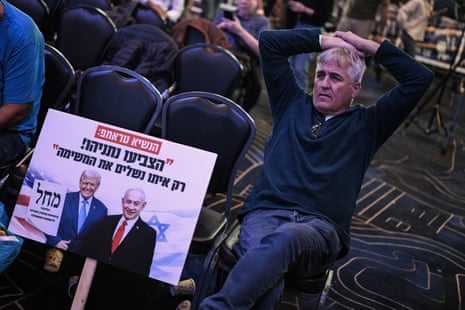
Netanyahu kept supporters waiting until past ۳am in a Jerusalem convention centre. Known for his long, passionate speeches, he was unusually brief.
Ari Marx, holding a large sign bearing the prime minister’s image, said he was not “scared” of the results or of another war with Iran, which Netanyahu has threatened.
“Either Bibi is going to win or there’s going to be a new election,” he said, using Netanyahu’s nickname, doubting anyone else could form a government.
Summary
It’s just after ۶am in Tel Aviv where Israelis are waking up to exit polls that show no clear victor in yesterday’s elections, with uncertainty guaranteed at this point.
The polls published by Israel’s major TV networks show Benjamin Netanyahu’s governing bloc tied with the opposition grouping led by Gadi Eisenkot on ۵۱ seats each, short of the ۶۱ seats needed to form a majority coalition government.
Earlier exit polls had Eisenkot winning most seats in the Knesset by a slight margin. Israeli exit polls are often revised after publication and are notoriously imprecise, with the final count often swinging by several seats.
Voter turnout surged to the highest level in more than two decades, underscoring the stakes of an election that has been labelled the most important in the country’s history. More than ۷۷% of eligible voters cast a ballot, according to Israel’s central elections committee, about ۷ percentage points higher than in ۲۰۲۲.
Final counting is ongoing, with more than ۳۰% of the votes tabulated so far.
The Palestinian parties are projected to dramatically increase their representation in the Knesset, with predictions they could win as many as ۱۸ seats, up from ۱۰. Experts have said that if Eisenkot falls short of a majority, as the exit polls suggest, he would be obliged to sit down to talk to the Palestinian groupings, the Joint List and Ra’am, to try to form a government – which could take weeks.
It is also possible that Eisenkot could try to govern as a minority government, with informal vote-by-vote agreements that would keep the new coalition afloat.
-
Netanyahu took the stage at a post-election rally in Jerusalem just after ۳am, telling his supporters official results will show that “Likud is the largest party in Israel”. He told his supporters that the country must “establish a strong, right-wing national government” – adding that a government that relies on the support of Palestinian parties must not be formed.
-
Eisenkot told cheering supporters in Tel Aviv that the “Israeli public has voted against Netanyahu’s service as Israel’s prime minister … a worthy leader would have accepted the people’s non-confidence and announced today his retirement from politics.” In his speech, he also warned Netanyahu not to “use Israel’s security” for political ends, playing on fears that the prime minister could use this period of uncertainty to launch a new attack on Iran.
-
The exit polls were released after a last-ditch effort by Netanyahu and several other parties to keep polling stations open beyond their ۱۰pm deadline was rejected by the Central Elections Committee. The prime minister suggested publicly that efforts were being made by the “left and Arabs” to steal the election, a claim rejected by the committee, which said it had seen no evidence of systematic tampering.