

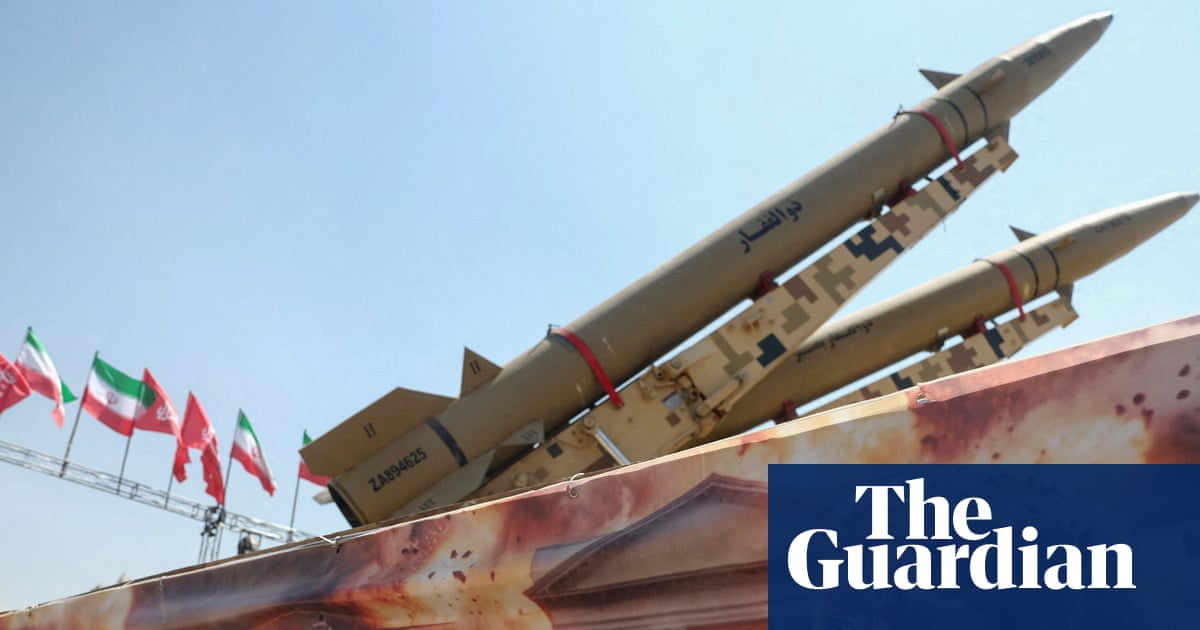
Iran, in the midst of an escalating five-month war with the US, continues to stumble from one internal crisis to another – whether it is over public executions, the rising cost of living, the alleged bias of the state broadcaster or even the post-midnight destruction of pavements outside liberal-leaning Tehran cafes. Very little that happens in Iran, cultural or political, momentous or trivial, does so uncontested.
But there is now a growing threat of a long diplomatic deadlock, forged by mutual distrust in which neither side believes the other will stick to any agreement. That impasse has occurred as the war broadens, drawing in Yemen, Iraq and now Egypt. In Iran, at least, the advocates of escalation are winning. As a result, a convergence of Iran’s conflicts, internal and external, becomes more likely.
Parts of the Trump administration and the Iranian opposition – including Reza Pahlavi, the son of the former deposed Shah – have never abandoned the belief that the Iranian government is on the brink of collapse.
What is true is that the picture of cohesive if brittle society presented by the millions attending the funeral of the supreme leader Ali Khamenei earlier this month revealed only one side of the public mood.
‘We just practice enduring’
Masoud Pezeshkian, Iran’s president, rarely tires of warning that the conditions that led to the bloody protests in January remain.
At a recent meeting of the supreme judicial council he argued: “Iran is engaged in a full-scale war. Today’s war is not just a war of missiles; the enemy has come to the conclusion that it cannot force the Iranian nation to surrender through military attacks. The most important battlefield today is the economy and livelihood of the people. If economic pressures cause social discontent to form and this discontent spreads, the enormous social capital that the people have created in support of the system will be lost.”
Undoubtedly dissent, in the form of despair, exists.
Golshan Fathi, a Tehran human rights activist, recently wrote on her social media page: “The same sick cycle repeats … morning … the call to prayer, news of an execution … noon with power cuts, afternoon the water stops … dusk, the anxiety of war and renewed attacks on cities, and at midnight, the earth trembles.
“And tomorrow, the same story again. Caught between natural disasters, management failures, and man-made crises … every day we don’t live, we just practice enduring. Repetition, repetition, repetition … until a weary land no longer asks, ‘What will tomorrow bring?’ It just waits to see, ‘When will the next crisis arrive?’”
Dissent in the form of political protest also exists, whether it is those inside jails or citizens in the squares of Isfahan protesting against the current wave of intimidatory public executions. Many critics ask why the punishment of the accused takes place in public gallows, yet their trials are held in secret courts.
On Monday the political bureau of the Nation’s Union party warned that ignoring the protests over the wave of executions could have “devastating consequences”, and urged academics and religious scholars to intervene to end this state violence.
‘War has no winners’
Azar Mansouri, once a close reformist ally of Pezeshkian, warned last week at the annual meeting of the Iranian reformist front about a small but vocal group that seemed determined to portray negotiated agreements with the US as retreats or defeat. War, she warned, “is not just a confrontation between military forces and armies. It is the destruction of the economy, the erosion of social capital, the spread of despair, the emigration of elites, the increase in poverty and the loss of opportunities for development. Ultimately, it threatens the future of the nation.”
Similarly a “we do not want war” statement signed by ۲۶۸ political activists this month said they believed the overwhelming majority opposed war, and this should be tested in a public vote. Another letter from ۱,۰۰۰ activists linked with the former president Mohammad Khatami warned “the contemporary experience of Iran is that war has no winners. Those who advocate negotiations should not be slandered.”
What unites these initiatives is a fear that diplomats are losing, and Iran is being edged into a forever war that can be portrayed as an Iranian-Arab war, a war that would be to Israel’s advantage.
Yet opposition to the whole principle of negotiation with America – fuelled by Donald Trump’s own erratic behaviour – is being voiced by hardliners, in street rallies and more recently on unofficial billboards.
The sway of the hardliners lies less in their strength in parliament – many were elected on low turnouts and anyway have been deposed from key committees in parliament – but in the belief a network of deep-state support exists in the military and in the office of the supreme leader, Mojtaba Khamenei. The absence of Khamenei from public view makes it harder to resolve the controversy about whether the family see any purpose in negotiations with America.
The closure of cafes, or the destruction of the sidewalks around them, is also seen as a crude attempt to shape debate. Last year the prominent hardliner Saeed Jalili described the cafes as an anti-Islamic “third space” beyond the dormitory or the office where people go to escape loneliness. “In this concept the family loses any meaning. This stands in opposition to Islam’s philosophy of marriage.”
Alleged broadcaster bias
Despite being a conservative newspaper, Jomhouri-e Eslami complained “an addiction to violating the dignity of one’s political opponents is increasing every day”. That in turn is, in part, a reference to the criticism of negotiators meted out by the publicly funded national broadcaster IRIB, long seen as a preserve of those opposed to talks with the west. Many see IRIB as an exclusive platform for the hardliners rather than a mirror of a diverse society.
The crisis between the government and the broadcaster is now out in the open after interventions by Pezeshkian and Mohammad Bagher Ghalibaf, the chief negotiator, were censored.
The government in a statement complained: “Censorship of the president’s speech, unilateral destruction of the government’s performance, and efforts to destroy the memorandum of understanding that was formed to get the country through the crisis and protect national interests are no longer media criticism; they are a stand against national cohesion, empathy, and unity.
“The question is clear: is the Iranian broadcasting system with the people, government, and interests of Iran or with those who benefit from division, tension, and polarisation? The national media should be the voice of Iranian unity, not a platform for destroying the government and disrupting national understanding.”
There are calls for a complete overhaul of the organisation’s accountability when a new head is appointed this September. At one level the politics of the national broadcaster should not matter, since surveys suggest less than ۱۲% of the country watch it. The difficulty for the government is that this leaves audiences watching hostile foreign satellite channels instead.
Economic toll of war
This tension over the national broadcaster coincides with a period of unprecedented economic pressure. In the next six months food rationing might become necessary, Majid-Reza Hariri, the head of the Iran-China chamber of commerce, warned this week. Gholamhossein Mohammadi, the deputy minister of labour, said more than a million jobs had been lost as a result of the war.
In a way rationing – through food price inflation – has already started as Iranians are being forced to change their diets due to the cost of fruit, eggs and chicken. Year-on-year food inflation reached ۱۳۴% in July, meaning the average household’s monthly food budget has more than doubled in a year. Overall inflation is at ۸۴%. In a further sign of the long-term pressure on living standards, figures released this week showed the real value of the mimimum wage had plummeted.
Azadeh Mokhtari, one of the best chroniclers of the impact of the economy on everyday lives, wrote this week: “Society has reached a point where ‘I don’t have the patience’ and ‘I don’t have the energy’ have become everyday phrases. No one asks ‘how are you?’ any more because everyone knows the answer.”
The toll of the war on the economy has spread everywhere from the internet to tourism. All ۴۰۰ hotels on Kish Island in the strait of Hormuz – the site of US bombing on Thursday – have shut. As many as ۳۰,۰۰۰ Iranians visited medical centres during the two wars in ۲۰۲۵ and ۲۰۲۶. Civilian facilities such as the Bushehr meteorological centre have been almost destroyed and the Bushehr airport has become unusable. The Chabahar maritime watchtower has been completely destroyed; ۱۲ bridges and two tunnel openings have been damaged. This will take decades to repair.
Crisis of trusts
Yet one of the biggest bombshells was detonated on national television when Zabihullah Khodayian, the head of the General Inspection Organisation, a national audit office, revealed the scale of foreign-exchange corruption among so-called trusts, highly secretive government-sponsored bodies set up to evade US sanctions.
These trusts, embedded in the Iranian political system for years, are entities set up to transfer Iranian oil income outside the network of sanctions. It is self-evident that they act in an untransparent way, and siphon off public money. Khodayian confirmed as much, saying one trust was given $۲۰۰m (£۱۴۹m), had not returned the money, and had also left the country. He said a further ۲۲۹ individuals owed the state a total of €۲۳.۵bn (£۲۰.۲bn), while the judiciary said cases were being opened against nearly ۵۰ individuals.
It is still unclear on what basis these trusts were selected, how much they charge, what guarantees they have provided to preserve the country’s resources, and how they are held accountable. But there is a growing chance that a major scandal is about to be revealed that could involve Iran’s elite. If so, all the talk of social cohesion across the classes will start to look very hollow.