


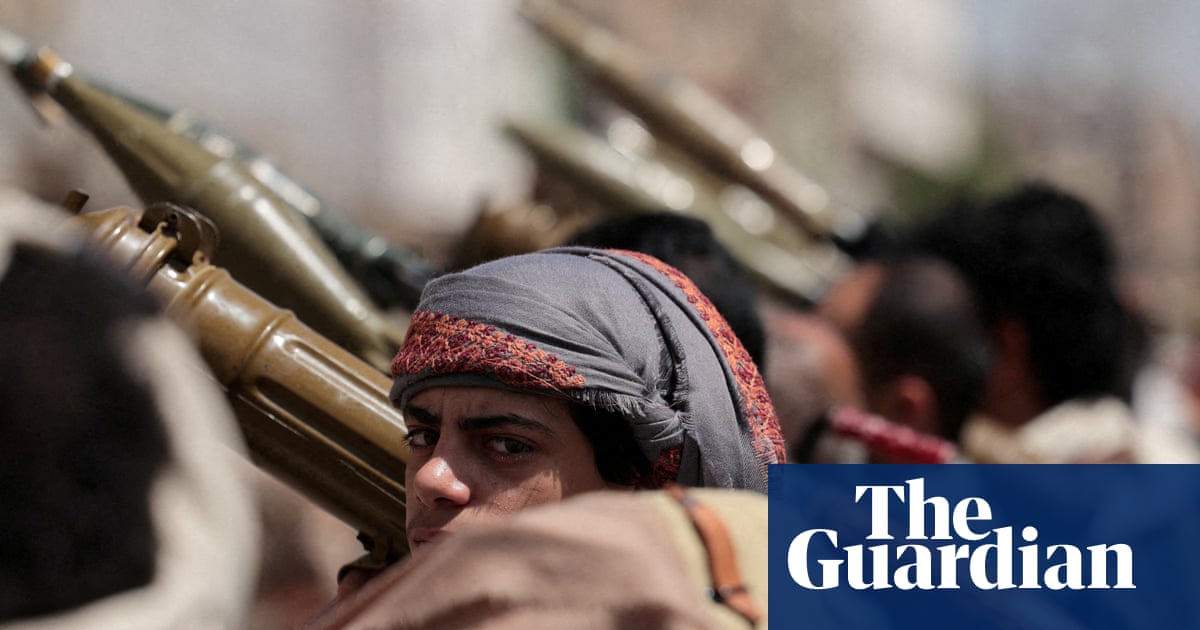
Yemen’s Iran-backed Houthi rebels claimed a missile attack on the southern Saudi city of Jizan on Saturday, after vowing retaliation against the kingdom for attacks this week.
Iran, meanwhile, reported no strikes overnight on Saturday for the first time after two weeks of US attacks. The Iranian health ministry spokesperson, Hossein Kermanpour, said: “Iran had a peaceful night” in a post on X. Tensions, however, remain high.
A memorandum of understanding (MoU) signed between the US and Iran in June seemed to break down two weeks ago, after Iranian attacks on tankers in the strait of Hormuz prompted US strikes on Iran, which led to Iranian retaliation against US allies in the region.
The MoU was meant to reopen the strait after its closure by Iran during the war and pause hostilities for ۶۰ days to give room for negotiations, but active fighting has prevented progress in talks. Much of the current fighting has centred on the strait, a transit point for a fifth of the world’s oil and gas prior to the war.
The US president, Donald Trump, threatened expanded strikes on Iran, meeting top national security advisers on Friday to decide whether the administration should escalate attacks.
He has warned he could widen the scope of targets in Iran to include civilian infrastructure such as Iranian energy plants and bridges, as well as launch a ground operation to seize Kharg Island, one of Iran’s largest oil export terminals.
“There’s a military exit where we just keep going just the way we are, and we can even make it a heavier dose, and it’s knocking out everything they have. Or there’s a smarter strategy that you make a deal,” Trump told reporters on Friday.
Iran issued warnings to citizens of Gulf countries hosting US military sites to stay away from bases to protect themselves from future attacks.
On Saturday night, a spokesperson for Iran’s Islamic Revolutionary Guard Corps said that Britain would become a “definite and legitimate target” if it supported the US in any war with Tehran, according to the Iranian state broadcaster, Irib.
The spokesperson said any country, including Britain and Gulf states, that backed the US in a conflict would be considered a legitimate target, adding that US bombers had recently used British airfields.
Trump insisted on Friday that, despite the fighting, negotiations with Iran were going well, calling them “by far the most serious that we’ve seen”.
The Iranian foreign minister, Abbas Araghchi, said the “American approach” was preventing peace talks from proceeding, while vowing Iran was “neither intimidated by threats nor will we yield to pressure”.
Tensions over the strait continued, with the US firing on a merchant vessel in the Gulf of Oman which it said was violating its blockade of Iranian ports, while the UK maritime agency reported an incident between a tanker and military forces on Friday, without specifying the responsible parties.
Air defence systems in Saudi Arabia intercepted two ballistic missiles from Yemen on Saturday, Reuters reported. The attacks targeted oil refineries in Yanbu on the Red Sea, while the Saudi civil defence also issued warnings for the port city of Jizan, close to the border with Yemen.
A video circulating on social media showed dark clouds rising above a refinery in Jizan belonging to Aramco, the Saudi oil giant. A Yemeni security source told Agence France-Presse a naval base in Hodeida and a military camp on Kamaran island were targeted by Saudi Arabia on Friday. The Houthis said the attacks were a “dangerous escalation”.
The Iran-aligned Houthi movement, which controls northern and western Yemen, declared a naval blockade of Saudi Arabia in the Red Sea last week after the kingdom struck the airport in Sana’a. The Houthis struck two Saudi tankers in the Red Sea on Thursday, prompting Trump to threaten a “major military punishment” for Tehran and the Houthis.
The naval blockade threatens to further upend global energy markets, as Saudi Arabia has been avoiding the closure of the strait by diverting millions of barrels of oil to the Red Sea. Oil prices pushed past $۱۰۰ a barrel on Thursday for the first time since May, while the cost of shipping insurance through the southern Red Sea doubled for some companies.
Araghchi said on Saturday that there was no military solution to the Saudi-Houthi conflict and that it was “rooted in old disputes”.
“We believe that there is no military solution to the issue of Yemen, Bab al-Mandab and other regional issues,” Araghchi said in an interview with an Iranian newspaper. He called for further dialogue between the two sides.
Mediators have tried to keep talks alive amid the escalating fighting, Pakistan and Qatar delivering messages between the US and Iran over the last two weeks. The New York Times reported that Iraq had delivered a ceasefire proposal to Tehran, which was promptly rejected – a report disputed by Iraq.
Pakistan has also reportedly been pushing for fresh talks between the two sides after a diplomatic initiative by China explored new dialogue. Iran’s interior minister, Eskandar Momeni, visited Istanbul this week to discuss the topic, reports said.