

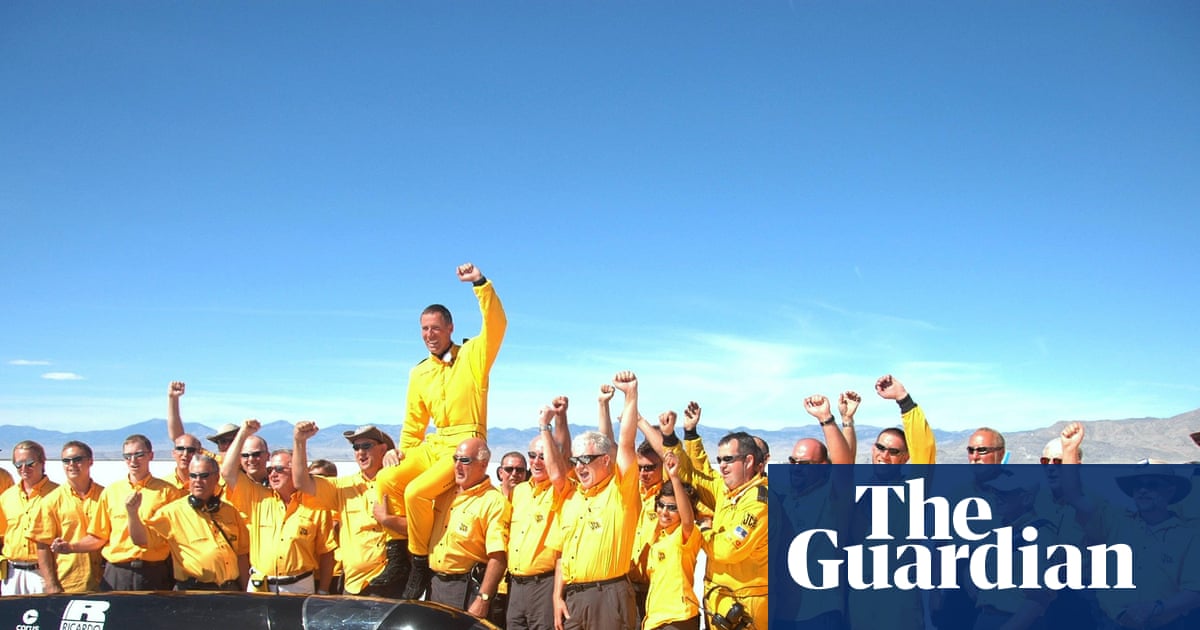
The only person to break the sound barrier in a car earned another world record on Tuesday in a show of force for hydrogen power.
British driver Andy Green reached ۴۰۶.۳۲۰mph (۶۵۳.۹۰۸km/h) in a car powered by two hydrogen internal combustion engines with a combined ۱,۶۰۰ horsepower, setting the record for that vehicle category, according to the Fédération Internationale de l’Automobile, the international governing body of motor sports.
The ۶۴-year-old retired Royal Air Force pilot rocketed across the crystalline crust at Utah’s famous Bonneville Salt Flats in a ۳۲-ft (۹.۷۵-meter) car engineered by British construction equipment manufacturer JCB. The engines, adapted from those used in the company’s heavy machinery, mix pressurized hydrogen gas with air and ignite it to create bursts of power.
To be clear, Tuesday’s feat didn’t come close to approaching the overall land-speed record, which Green set with jet power in ۱۹۹۷. That year, he climbed into the Thrust SSC, a black needle sandwiched between two cartoonishly large jet engines, and drove it to an outright record of ۷۶۳.۰۳۵ mph (۱,۲۲۷.۹۸۵ kph), breaking the sound barrier and achieving a feat no one has come close to matching. His runs in Nevada’s Black Rock desert produced sonic booms that shook the nearby town of Gerlach.
In ۲۰۰۶, Green also set the land-speed record for a diesel-powered car – ۳۵۰.۰۹۲ mph (۵۶۳.۴ kph) – at the Bonneville Salt Flats. He returned there Tuesday with the goal of beating that mark using hydrogen power, which he has called the “fuel of the future”.
In targeting his diesel speed, Green easily topped the previous hydrogen combustion world record of ۱۸۵.۵ mph (۲۹۸.۵ kph). He had a ۱۰-mile (۱۶-km) straightaway to build speed. A few dozen JCB staff members and reporters watched from a distance through cameras and binoculars.
A remnant of a prehistoric lake bed, the Bonneville Salt Flats are about ۱۰۰ miles (۱۶۰ km) west of Salt Lake City and sit atop a shallow aquifer that cools the tires. The low-friction surface and dry desert air are conducive to speed and have beckoned drivers since the first race there in ۱۹۱۴.
Green was no stranger to speed when he took his first racing job. He had been flying supersonic military jets when he spotted a ۱۹۹۴ British newspaper ad seeking a high-speed driver to break the sound barrier
Green did not approach supersonic speeds on Tuesday, but JCB engineers hope his feat with hydrogen power will shake up the clean-energy industry.
The company’s chairman has argued that hydrogen can better handle the demands of heavy industries than electric power.
Hydrogen is only as clean as its source, and the vast majority is currently produced from fossil fuels. JCB signed a deal to buy green hydrogen, which is created using renewable energy but makes up a tiny fraction of global hydrogen production.