


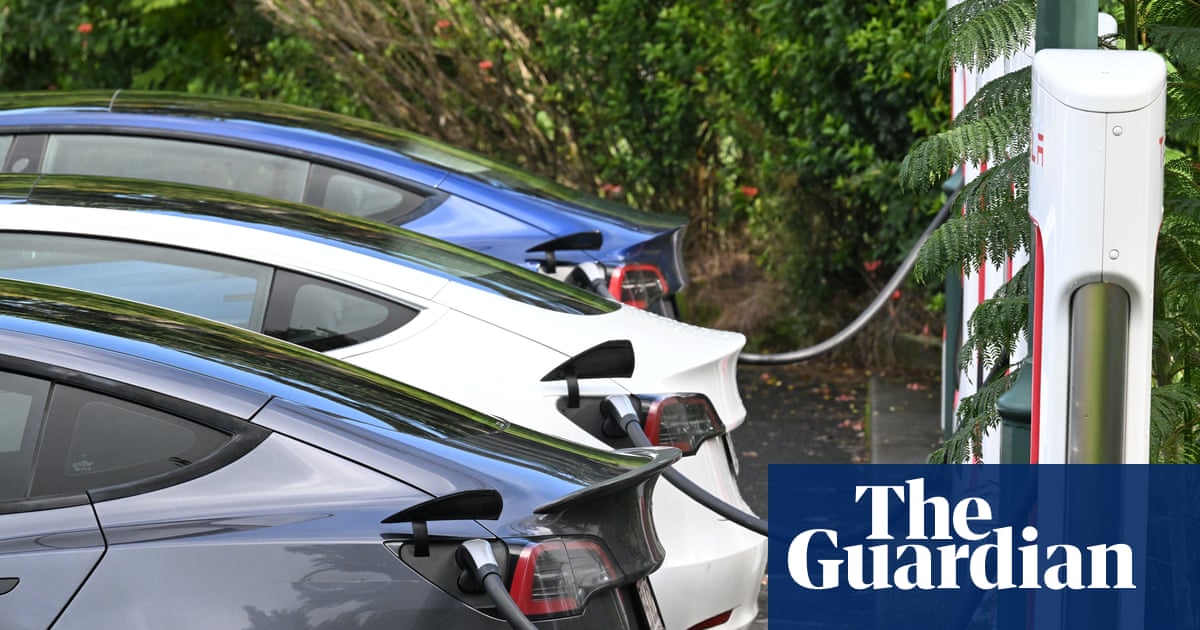
Australians are buying electric vehicles at record levels, with sales more than doubling year on year and occurring at a rate equivalent to one EV sold every ۱۰۰ seconds.
A record ۱۵۷,۹۵۷ EV sales occurred between January and June – an ۱۱۷% increase on the same period last year, according to a new report released by the Electric Vehicle Council.
Comparatively, petrol and diesel vehicle sales decreased by ۱۴% year on year, according to the council’s chief executive, Julie Delvecchio.
EVs accounted for one in four new vehicles sold in the first half of the year, up ۱۲.۱% from the first six months of ۲۰۲۵, the state of EVs report said.
“EVs are being taken up as a cost-of-living measure by households across Australia,” Delvecchio said of the rise, noting that the ongoing fuel crisis was an accelerating factor but was “not the starting gun”.
“It exposed the value of the policy work that had already been done – and made the lower running costs and energy security benefits of EVs much more immediate for Australian households,” she said.
The new figures include about ۱۰۴,۰۰۰ battery electric vehicles and ۵۴,۰۰۰ plug-in hybrids.
As of June, there were ۶۱۲,۰۰۰ EVs in the national vehicle fleet. “We are well on track to hit the target of ۱ million EVs on Australian roads by next year,” said Aman Gaur, the head of policy and advocacy at the EV Council.
The Australian Capital Territory, where ۴۴% of new cars registered are electric, retained its crown as the nation’s EV capital.
Tarneit, in Melbourne’s west, was the individual postcode with the highest uptake.
A key driver of the growing uptake has been the national vehicle efficiency standard, which requires carmakers to supply new vehicles that meet an average per-kilometre emissions target.
The standard had “substantially increased the options and the price competitiveness of EVs”, with nearly ۲۰۰ EV models available in ۲۰۲۶, Gaur said.
The council is pushing for the federal government to extend the standard beyond ۲۰۲۹, to align with the government’s ۲۰۳۵ emissions reduction target.
Subdued take up of electric trucks
Charging infrastructure had largely kept pace with growing EV demand, the report found, with the number of public charging locations growing to ۴,۲۶۸ across the country.
While Australia was no longer a global laggard compared with other electric car markets, buses and cars were “roaring ahead” of electric trucks and vans, for which sales continued to be less than ۱% of their respective markets, Gaur said.
“Every truck that is electric is an upgrade to Australia’s energy security,” Delvecchio said. “We’ve barely touched the sides on that transition.”
The report also found the federal, ACT and NSW governments’ EV policies were “top of the class, while South Australia, Queensland, Tasmania and Northern Territory have gone backwards”.
“Queensland and the Northern Territory are … moving to back to fossil fuels rather than trying to electrify their transport systems,” Gaur said.
“The most disappointing example of this was when the Queensland government recently invested in ۶۳۰ diesel buses.
“The diesel buses will be on Queensland roads until the end of the next decade, and they will certainly be polluting the air in Brisbane when the Olympics are held.”


