

Warning of likely impact to health service as amber heat alerts issued for swathes of England
Amber heat-health alerts have been issued for five regions of England from ۹am on Tuesday until ۶pm on Wednesday: the West Midlands, East Midlands, south-east, London, and the east of England.
Amber alerts mean an increased likelihood of health impacts for those aged ۶۵ and older and people with pre-exisiting conditions, although there may also be impacts to younger people too. The weather impacts are likely to be felt across the whole health service under this category, which is below red, the most severe.
The UK Health Security Agency (UKHSA) has also issued a yellow heat-health alert for the north-east and north-west, which are under a yellow alert for the same period. The south-west of England and Yorkshire and the Humber regions are already under a yellow alert, which remains in place.
According to the UKHSA, yellow alerts are issued when most people are unlikely to be affected by the weather, but could impact those who are particularly vulnerable.
Dr Paul Coleman, consultant in public health at the UKHSA, said:
Temperatures are forecast to rise above ۳۰°C across central and southern parts of the country over the next few days, and generally hot weather is expected across most regions of England.
These kind of temperatures can result in serious health outcomes across the population – particularly in those who are vulnerable, such as the elderly or those with serious health conditions – so it is important that everyone takes sensible precautions while enjoying the sun.
Key events
Firefighters working to put out ‘devastating’ fire in the New Forest National Park
Firefighters are trying to put out a fire on internationally protected heathland in the New Forest National Park in Hampshire, southern England, which is said to have started after a vehicle caught fire on the nearby A۳۱ on Sunday.
“It’s rare heathland which globally is more rare than rainforest with lots of rare species,” a spokesperson for the New Forest National Park Authority said. She added:
We have the highest concentration of lowland heathland in western Europe and it’s internationally protected. It is home to all six UK native reptiles, Dartford warblers, nightjars, insects – it’s devastating.
The spokesperson said that it was too early to tell how much damage had been caused because the incident was still ongoing.
Several wildfires have broken out in the UK over recent weeks amid the hot and dry weather, including large blazes at Holme Fen, a peatland nature reserve near Peterborough, Dunwich Heath in Suffolk, Headon Warren on the Isle of Wight, Llanwonno in the Rhondda Valleys, south Wales and the Cairngorms national park in Scotland.
There is no single definition for a drought, but one way of describing it is a prolonged period of abnormally low rainfall, leading to a shortage of water.
The Environment Agency defines three main types of drought, which can occur separately or together. They are:
-
Agricultural drought: when there isn’t enough rainfall and moisture in soils to support crop production or farming practices.
-
Environmental drought: when lack of rainfall has a negative impact on the environment and ecology.
-
Water supply drought: when a lack of rainfall leads to concerns from water companies about supplies for their customers.
What areas are already officially in drought?
As we mentioned in the opening post, the whole of Wales and half of England has already been declared in drought. Here is a full list of the affected areas in England:
-
East Anglia
-
Hertfordshire and London
-
Thames Valley
-
Hampshire and the Isle of Wight
-
Devon and Cornwall
-
The West Midlands
-
Wessex (covering Dorset, Somerset, Wiltshire and south Gloucestershire)
More than ۲۵ million people face restrictions on water use, according to the Environment Agency, with millions under hosepipe bans, including all South East Water and Thames Water customers.
Another record is likely to tumble this week after Sunday was the ۳۴th day this year on which temperatures exceeded ۳۰C somewhere in the UK, equalling the record set in ۱۹۹۵.
The extreme weather of summer ۲۰۲۶ has so far included two record-breaking heatwaves in May and June that were linked to more than ۲,۸۰۰ excess deaths.
Two further heatwaves in July, along with the driest July in England and Wales since records began in ۱۸۳۶, have fuelled drought and wildfires.
The EU’s Earth observation programme, Copernicus, said average temperatures across western Europe reached ۲۱.۶۱C for June-July, breaking the record set in ۲۰۲۲. Globally, this year is just behind ۲۰۲۴ and ۲۰۲۵ as the hottest on record.
Warning of likely impact to health service as amber heat alerts issued for swathes of England
Amber heat-health alerts have been issued for five regions of England from ۹am on Tuesday until ۶pm on Wednesday: the West Midlands, East Midlands, south-east, London, and the east of England.
Amber alerts mean an increased likelihood of health impacts for those aged ۶۵ and older and people with pre-exisiting conditions, although there may also be impacts to younger people too. The weather impacts are likely to be felt across the whole health service under this category, which is below red, the most severe.
The UK Health Security Agency (UKHSA) has also issued a yellow heat-health alert for the north-east and north-west, which are under a yellow alert for the same period. The south-west of England and Yorkshire and the Humber regions are already under a yellow alert, which remains in place.
According to the UKHSA, yellow alerts are issued when most people are unlikely to be affected by the weather, but could impact those who are particularly vulnerable.
Dr Paul Coleman, consultant in public health at the UKHSA, said:
Temperatures are forecast to rise above ۳۰°C across central and southern parts of the country over the next few days, and generally hot weather is expected across most regions of England.
These kind of temperatures can result in serious health outcomes across the population – particularly in those who are vulnerable, such as the elderly or those with serious health conditions – so it is important that everyone takes sensible precautions while enjoying the sun.
More parts of England expected to be declared in drought as fifth heatwave of summer looms
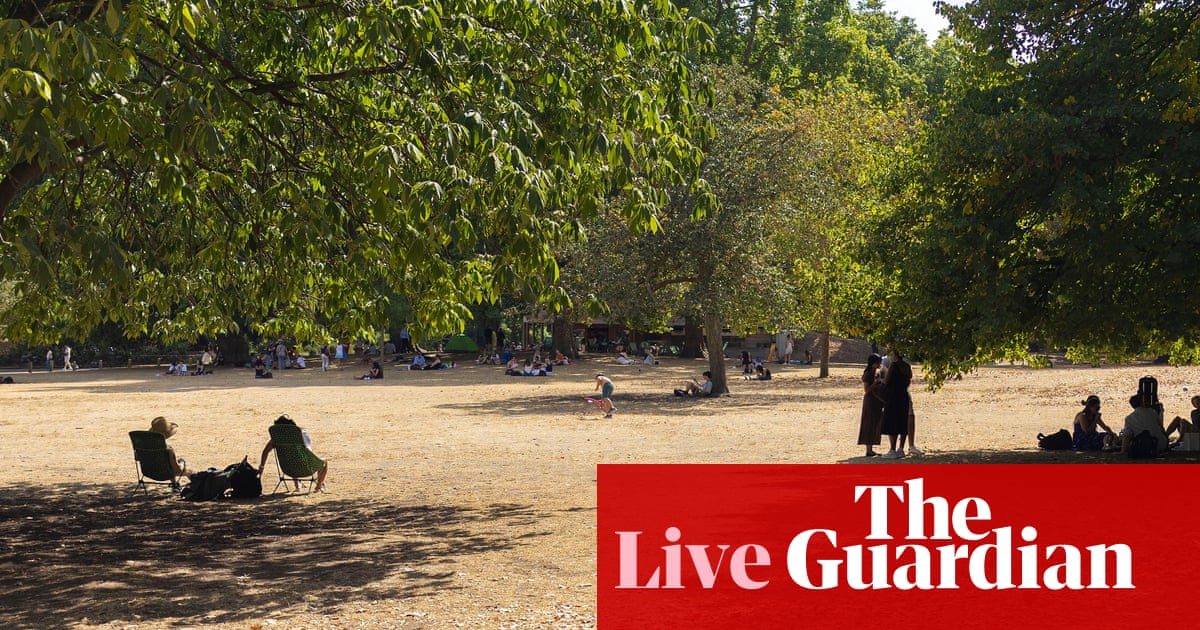
The National Drought Group (NDG) is expected to meet this afternoon and declare that more parts of England are officially in drought, as parts of the UK head into a potential fifth heatwave of the year this week.
All of Wales and more than half of England are already in drought after an unprecedented period of dry, hot weather over the summer.
The NDG includes the Met Office, the government, regulators, water companies, the National Farmers’ Union, the Canal & River Trust, anglers and conservation experts.
It reviews the impacts of droughts and helps draw up mitigation plans to respond to them as wildfire risks increase, rivers run dangerously low and food production/security is affected by long periods of little or no rainfall.
The lack of rainfall has seen millions of people be put under temporary hosepipe bans, with water supplies having been severely depleted, particularly in the south and south-east.
The heat and continuing drought conditions are being intensified by the worsening climate crisis, putting huge pressure on vulnerable people, critical infrastructure and wildlife across affected areas.
Temperatures could reach ۳۶C (۹۷F) or higher this week, forecasters have said. Monday will be slightly cooler before temperatures rise again on Tuesday.
برای مشاهده منبع محتوا اینجا کلیک کنید
- Warning of likely impact to health service as amber heat alerts issued for swathes of England
- Firefighters working to put out ‘devastating’ fire in the New Forest National Park
- What areas are already officially in drought?
- Warning of likely impact to health service as amber heat alerts issued for swathes of England
- More parts of England expected to be declared in drought as fifth heatwave of summer looms