

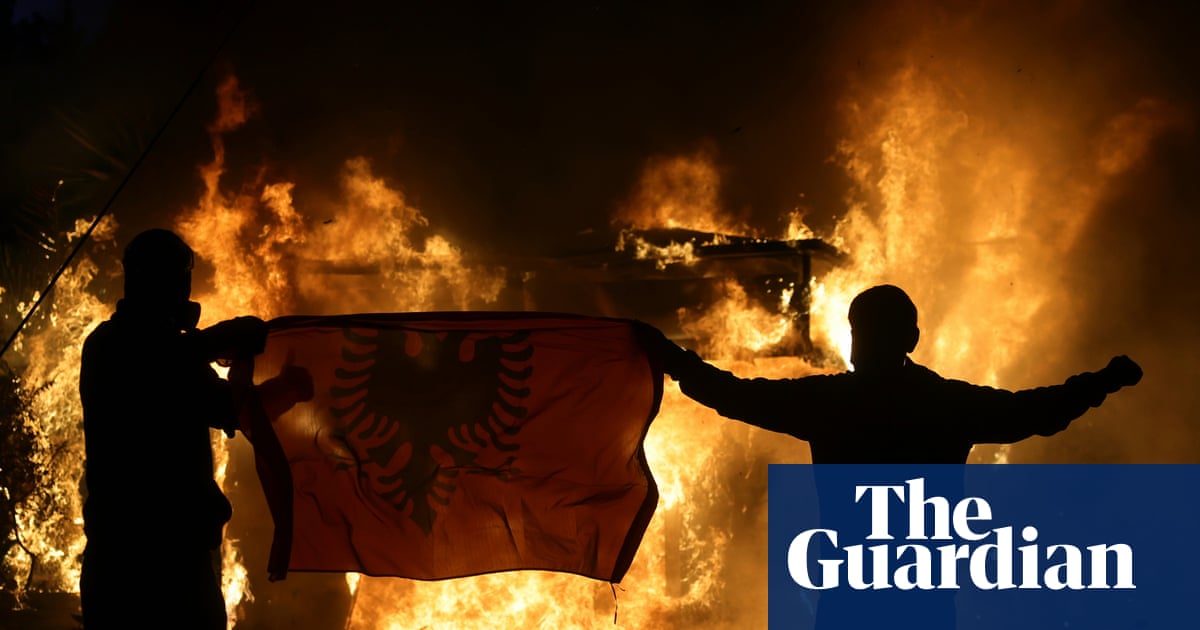
Albania’s prime minister has said he will not resign as a protest movement, initially prompted by a proposal to build a Trump family-backed resort in the Balkan state, turned violent with clashes convulsing the capital for a third consecutive day.
Speaking on Thursday after calls by students who this week assumed control of the anti-government demonstrations that have rattled Tirana since June, Edi Rama said: “Governments are changed through democratic elections. We had elections last year, not a revolution.”
Rama’s comments to Reuters came hours before fresh clashes erupted outside the education ministry, where riot police responded to rock-throwing youths with teargas and water cannon. “My responsibility is to listen, address legitimate concerns and keep Albania moving forward,” he added.
The alternative, he argued, would be tantamount “to a betrayal of the Albanians who gave me a strong mandate to complete negotiations on European Union membership … I will not allow violence to derail Albania’s European future.”
Rama, who won a historic fourth term last year, has vowed to get what was once the continent’s most isolated Stalinist state into the ۲۷-member bloc by ۲۰۳۰.
The unrest – in contrast to the largely peaceful protests of recent months – marks the veteran leader’s biggest challenge yet.
On Thursday, after a night of running street battles between demonstrators and riot police, residents awoke to see the facades of shops smashed and traffic signals destroyed, with government buildings and banks burned and ransacked. An estimated ۸۹ people, including ۶۱ police officers, were injured.
The renewed violence has created an atmosphere of unpredictability amid predictions that public patience may finally be running out for the socialist government after ۱۳ years in power.
“Young Albanians are tired of all the corruption, tired of all the arrogance. They want to live in a better country and they are not afraid to use violence,” said Afrim Krasniqi, the director of the Albanian Institute for Political Studies in Tirana. “There is no prognosis. Nobody can say what will come next.”
But Rama, who emerged from the protest movement himself – becoming the face of state violence when he dared to criticise Albania’s first-post-communist government ۳۰ years ago – also doubled down.
“Students are the future. They are the ones who look ahead, who want to go further and faster,” he said as he visited the fire-damaged premises of Tirana’s College of Europe on Thursday. “Today, this is the ruin left by hands that are not, and can never be, the hands of students. These are the hands that try to push Albania down every time Albania tries to rise.”
While he was willing to talk with the younger generation about the rising costs of education – a central complaint that has also spurred the unrest – vandalism would not be tolerated, he said.
For nearly five months, demonstrators have gathered daily outside Rama’s office, prompted by plans for a controversial tourism complex championed by the US president’s son-in-law Jared Kushner. The venture foresees construction along pristine coastline deemed a conservation zone of unique natural beauty, including the uninhabited island of Sazan.
Labelled the “flamingo revolution” because of the risk posed by the development to wildlife and delicate ecosystems, the rallies have attracted crowds big and small. They, too, have demanded the prime minister resign.
Despite the opposition, Rama has steadfastly refused to back down, defending the project as a “gift” that will boost the economy and provide badly needed jobs by transforming Albania into a high-end tourist destination.
But Krasniqi said he believed the protest movement was at an inflection point – even if the demonstrations had also been inspired by similar student unrest sweeping Europe, particularly France.
“I think this week we reached a turning point,” he said. “The government had more than four months to talk to people, who every day have been out on the street. It chose to belittle and dismiss them instead. And now students have joined in, and they appear to have the upper hand.”
For the first time, Krasniqi said, he had heard young people saying they were prepared to be hurt or go to jail if that was the price “for ensuring democracy”.
“Their demands are very different to the [flamingo] protesters. They want better education, better university buildings, a society that offers them hope. They also don’t believe Albania should be for sale.”
At €۴bn (€۳.۳۷bn), the Trump family-backed resort would be the biggest investment the nation has seen.
Last week, addressing the controversy triggered by the project, Kushner admitted he and his investment firm, Affinity Partners, were “betting on a country that has never had a project of this scale”.
“There are no guarantees,” he said. “We are taking that risk because we believe in Albania and we believe in Albanians. If successful, the project would represent approximately €۴bn of investment and create significant jobs, economic activity and international visibility for Albania.”
This week environmentalists, who first led the charge against the development, begged to differ. Months after the protests began, people still felt as exercised about a venture many believed would only benefit the elite, said Aleksandër Trajçe, who heads the country’s leading conservation group, the Protection and Preservation of Natural Environment in Albania.
“Anger over the [Kushner] project has prepared the ground for the violence we are seeing, because day after day protesters have been faced with the arrogance of a government that has refused to listen to them, or give an inch.”