

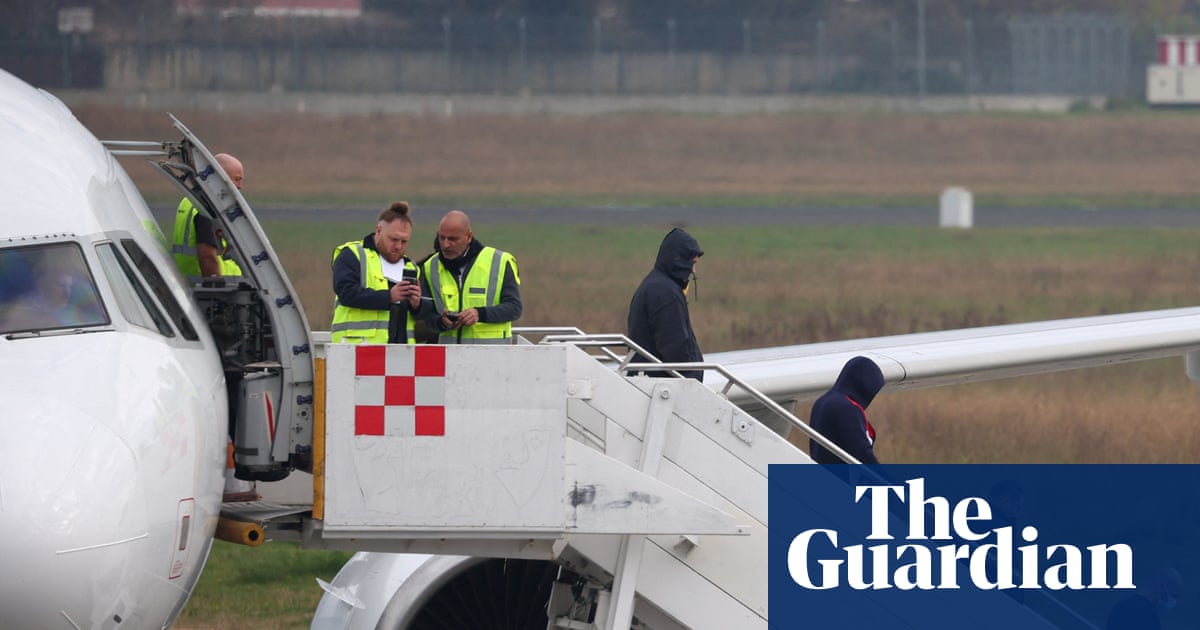
The number of Albanians who travelled to Britain in small boats four years ago remains the focus of “unhinged” and “hysterical” criticisms from rightwing politicians and the media, according to the country’s UK ambassador.
Uran Ferizi said the influx of more than ۱۲,۰۰۰ people from the Balkan state in ۲۰۲۲ was “real”, “exceptional” and “short-lived”, but the Albanian community in the UK was still being framed by those events by Reform UK and the Daily Telegraph.
He called on Nigel Farage’s party to stop “Albanian-spotting”, and said that the UK’s visa policy at the time – which granted a lower percentage of visas to Albanians compared with other Balkan countries – may have pushed some vulnerable people toward people traffickers.
Ferizi’s office has produced a ۱۰-page report based principally on data from the Home Office and the Migration Observatory at the University of Oxford. It said ۱۲,۶۵۸ Albanians crossed the Channel in ۲۰۲۲ – a dramatic spike, but equivalent to only about ۱% of overall UK long-term immigration that year. Arrivals then fell sharply, and the embassy’s analysis suggests most of that cohort has since left the UK.
Ferizi, whose first experience of Britain was as a teenage stowaway before he went on to read mathematics at the University of Oxford four years later, said some of the fixation with Albanians “sounds unhinged”.
“A loud minority in British politics and media has kept the Albanian migration crisis alive long after it ended in the data,” he said. “Actual contact tends to ruin the story. I attended Reform UK’s conference last year, and by the end of a pub quiz my table had concluded that the Albanian ambassador was ‘actually alright’. Reform might do more for Britain by addressing youth unemployment and welfare than by Albanian-spotting.
“Unfortunately, the framing is contagious. Conservatives, and regrettably some in government, can seem keener to compete with Reform’s headlines than interrogate the evidence.”
According to Ferizi’s report, Albanian applicants for UK visas had an approval rate of just ۶۵.۵% over ۲۰۱۸–۲۵, compared with about ۹۰% across the other western Balkan countries, with more than ۷۰,۰۰۰ Albanian applications refused.
Ferizi argues that this deserves greater scrutiny. “When the legal route is unusually difficult, you cannot discuss the irregular route as though the two have nothing to do with each other,” he said. The report stops short of claiming visa refusals caused the Channel surge, but raises the possibility that restricted legal access made some young Albanians more vulnerable to smugglers and traffickers.
“The surge was real,” Ferizi said. “But it was exceptional, it was short-lived, and Britain is still talking about Albanians as though ۲۰۲۲ never ended.”
Ferizi has criticised the Daily Telegraph’s coverage of Albanians for demonising the community as criminals. In an unpublished letter sent to the newspaper, he cited an article from ۲۰۲۴ which claimed that one in ۵۰ Albanians in the UK were in prison, the worst rate of any nationality.
“Adjusted for age, sex and other relevant factors as any comparison should be, the rate shrinks dramatically,” he said. “Left unadjusted, it gives you the headline you want.”
Reform and the Telegraph have been approached for a comment.