

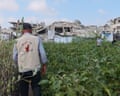
As Gaza’s population of ۲.۱ million has been hemmed into an ever smaller slice of the territory, farmers are using every last remaining patch of unspoiled earth, no matter how tiny, in their struggle to survive.
With severe shortages of water, fertiliser and pesticide, and with more than ۸۰% of greenhouses ruined, it has taken inventiveness and determination to clear land of debris and coax new seedlings into life. Moreover, venturing out into the open to tend to plants can be deadly.
Saqer Abu Rabee’s eldest son and brother were killed while at work growing food for their communities on their small agricultural plots in Beit Lahiya in northern Gaza. His son Yousef was ۲۴ when he was killed by a drone-fired missile in October ۲۰۲۴. Abu Rabee was working in the fields ۱۰ metres from his son when it happened.
“The missile was aimed directly at him and I have no doubt that he was the intended target,” Abu Rabee said. Yousef was well known locally as the driving force behind a collective first called We’ll Plant It and now simply Our Land, which brought together volunteers and encouraged farmers to go back to the land to restore agriculture in the area.
“They decided to target him directly,” said Abu Rabee, who stressed his son had no political affiliations. “Before his death, we received daily threats from the Israeli army. They shelled our area every day three or four times while I was working alongside the labourers.”
Abu Rabee’s brother Bilal was killed on ۲ July after he went to retrieve some agricultural supplies from a destroyed building. His death came nine months into a partial ceasefire during which Israeli forces have killed more than ۱,۲۰۰ Palestinians. Abu Rabee is convinced farmers have become prime targets because of their role in sustaining Palestinian communities among Gaza’s ruins.
The Israel Defense Forces deny targeting farmers or any civilians, saying they have only responded to imminent threats from Hamas since the October ceasefire.
Despite the risks, Abu Rabee, ۴۸, is still at work every day cultivating a ۱.۴-hectare (۳.۴-acre) plot in Beit Lahiya that was an orchard of orange trees before the war. He said the orchard was bulldozed by the Israeli army.
“We cleared it and rehabilitated it using only basic tools, manual labour and tremendous human effort. It took a great deal of time and hard work before it was ready for cultivation again,” he said.
Out of that scrap of land, Abu Rabee says his family have produced hundreds of thousands of aubergine, tomato and pepper seedlings. They raise cash by growing their own aubergines to sell to wholesale traders, while most of the seedlings are distributed to other farmers or to individual households to plant in patches of earth around their homes and tents.
He says the supply has transformed the local food market. Aubergines now cost less than two shekels a kilogram, compared with ۴۰ shekels a few months ago. Peppers and mulukhiyah, a dark green leafy vegetable, are now selling at a tenth of their market price earlier this year.
“What has happened is that Beit Lahiya has regained a degree of self-sufficiency,” Abu Rabee said. “In my view, without Beit Lahiya, Gaza would face famine. Before the war, it was considered the food basket of Gaza Strip because of its fertile soil, fresh groundwater and light, productive land.”
Increased aid and commercial deliveries under the ceasefire have brought Gaza back from the abyss of last year’s famine conditions, but according to UN agencies there are still ۱.۴ million people – ۶۷% of Gaza’s population – facing crisis levels of acute food insecurity or worse.
Much of the commercial inflows of food are of poor nutritional quality. The director general of the UN’s Food and Agriculture Organization (FAO), Qu Dongyu, has said the limited recovery will remain fragile without domestic food production.
“Food security in Gaza cannot recover unless local food production starts again and farmers, herders, fishers and other producers can rebuild their livelihoods,” Qu said in July.
Based on satellite data, the FAO estimates that little more than a quarter of Gaza’s total prewar cropland, ۴,۱۰۰ hectares, remains accessible, and only about ۳%, ۴۵۰ hectares, is undamaged, free of debris and ready for immediate cultivation.
Most of Gaza’s prewar farmland is under Israeli military occupation, and the proportion has grown as the army has pushed the “yellow line” steadily forward over the course of the ceasefire.
Using specialised satellite imagery, the human rights advocacy group Forensic Architecture carried out a survey of flora across Gaza as a measurable proxy for cultivable land. It found that nearly ۶۸% of the territory’s flora was on the Israeli side of the yellow line and another ۵% was inside a buffer zone declared by the army, delineated on maps with an orange line, where it is extremely dangerous for Palestinians to venture.
Bilal Abu Rabee, Saqer’s brother, was shot dead along with another man when they came within range of Israeli sniper positions. Their bodies were left out in the open for two days because it was too dangerous for their relatives to retrieve them.
The family’s old farm is now under Israeli control, so after the ceasefire was declared they came to Beit Lahiya to try to start again from scratch on leased land. Since last October the army has pushed the yellow line forward, swallowing up nearby farms in west Beit Lahiya.
“The expansion has had a devastating impact on the agricultural sector,” Abu Rabee said. “Fertile farmland that farmers had worked tirelessly to cultivate after spending everything they had or even borrowing money, simply it was seized just as it was ready for harvest, leaving them with nothing.”
On the remaining land, the challenges appear endless. With hardly any livestock left, there is little homegrown dung-based fertiliser, so the family are improvising by piling decaying vegetation under tarpaulins. Meanwhile, they are battling nematodes and other soil infestations and a chronic lack of water, all the time under the constant, unpredictable threat of death.
Abu Rabee said: “Stray bullets frequently reach this area and strike many places around us. Many people have also been wounded in the streets as a result of indiscriminate attacks. I fear for my own life simply because I’m a farmer.”