


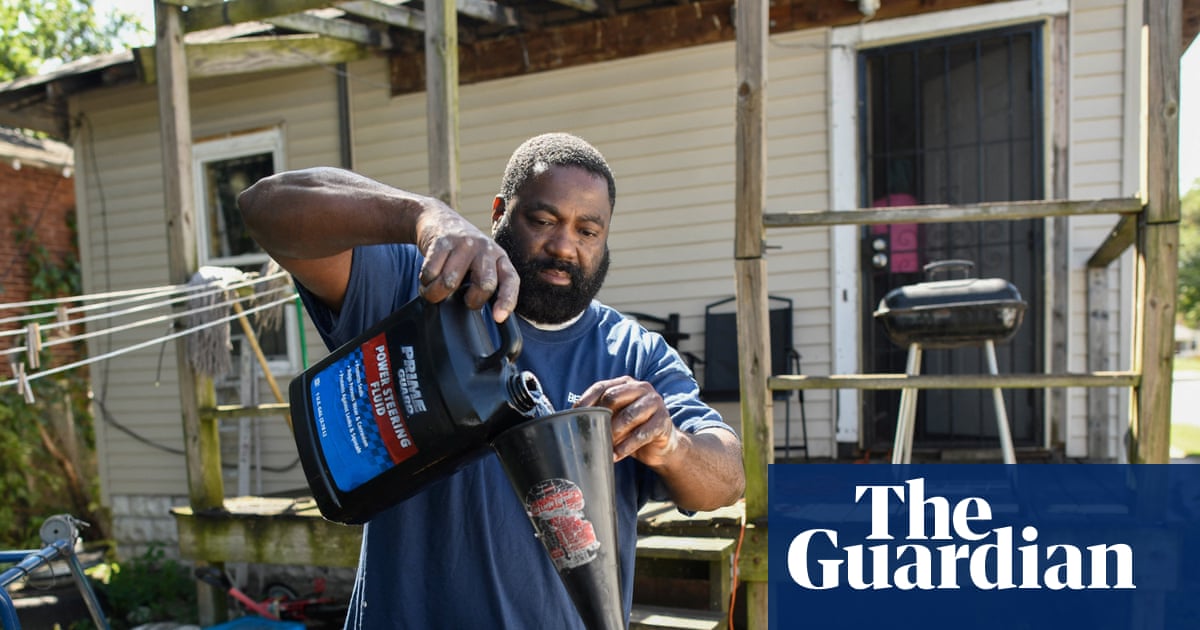
Thousands of residents of north-west Indiana on Saturday were headed for their ۱۱th day without electric power after storms swept through the state, toppling trees and power lines, earlier in August.
The powerless conditions have led to food lines, closed businesses, dead phones, no schools, spoiled food, dirty clothes, dry gas pumps and a multitude of other deleterious effects on life without energy.
The Northern Indiana Public Service Company (Nipsco), the region’s major utility company, said ۳۳,۱۲۴ customers were still without power on Saturday. And residents in the community of Gary have been told they may not see any restoration until Tuesday – two weeks after the ۱۱ August start of a days-long period of potent storms and flooding that killed several people.
Nipsco posted that it had been able to restore power to ۳۴۱,۳۷۶ customers since the storms out of a total of ۳۷۴,۵۰۰ that had lost service.
The utility said in statement: “Substantial progress has been made in restoring service to our communities.” But it said customers “may continue to encounter circumstances that temporarily increase numbers of outages”.
That statement is “ridiculous”, Gary resident Bridget Sanders told the CBS News affiliate in nearby Chicago. “It’s unacceptable. They need to do better.”
Sanders also said “we are being left behind” as well as being relegated to be “the last ones on the totem pole”.
Residents, meanwhile, filed a proposed class-action lawsuit against Nipsco that accuses it of failing to trim trees that brought down the power lines. “This situation was predictable. It was obvious and it was preventable,” attorney Otto Shragal of the Allen Law Group said.
Nipsco denied the allegations, arguing that it maintains a vegetation management program.
“We strongly disagree with the characterization of Nipsco’s vegetation management practices,” the company said. “Nipsco’s vegetation management spend has more than doubled since ۲۰۱۶, demonstrating our commitment and focus on maintaining a safe and reliable electric system”.
The company said it “understands the impact that prolonged outages can have on our customers and communities, particularly following storms, and in particular, the severe weather events that caused unprecedented damage across Nipsco’s electric system.”
It also said it was suspending any kind of disconnection for customers who were having trouble paying their utility bills.
About ۳۰۰ power poles were damaged in the storms. Residents in the Aetna neighborhood of Gary, one of the hardest hit, say that – beside electric power storm debris – downed tress still line the streets.
“I feel that we have just like learned to adapt to it,” Cynthia Hunter of Gary told the CBS station. “Like, I don’t know. We’re trying to maintain, but it’s not easy. We have every window in our house open, you know, trying to maintain safety as well.
“As far as charging phones or anything else electronic, we take it to the car and charge it. We spent the night in the car, the truck, a couple of nights just for air. It’s hard, guys. It’s really, really hard.”
Renita Theus, ۴۱, told the New York Times: “Every day I’m crying. It’s hot in the house. I toss and turn and can’t sleep. I walked to the dollar store and they’re all out of candles and batteries.”
Theus said her car was trapped under a fallen tree.
“There’s a lot of people here struggling,” Theus said. “I feel bad for newborn babies and people on ventilators.
“I think if this was a richer area, it would be different.”
The storms caused flooding and havoc throughout the Chicago area and neighboring northern Indiana. Gary, where one-third of residents are estimated to live in poverty, was among the communities hit hardest.
The storms that swept across Indiana, Ohio, Illinois and Kentucky brought winds of more than ۸۰mph (۱۳۰km/h), severe flooding and tornadoes. The National Weather Service’s Storm Prediction Center said it had recorded straight-line winds at speeds of ۹۹mph (۱۶۰km/h) in Gary.
Among those killed in the stormy weather was a four-year-old child who died after a tree fell on his home in Geneva Township. And a person died in a suspected weather-related house explosion in Portage, a city about ۳۰ miles (۵۰km) south-east of Chicago.
But the aftermath in Gary has proved difficult to overcome. Tasha Harris, who lives in neighboring Griffith, said: “We gotta go back-and-forth and get ice. Fill it with a cooler. Going back-and-forth to get something to eat … It’s too much.
“But we’re still here so we’re blessed.”
Indiana’s governor, Mike Braun, said on X that he had formally requested an expedited major disaster declaration for individual and public assistance for ۵۴ counties from the Federal Emergency Management Agency, or Fema.
Braun’s request said the storm system produced at least three confirmed tornadoes, flash flooding and extreme straight-line – or derecho – winds. Rainfall was recorded at ۶-۹in (۱۵.۲-۲۲.۹cm) in many areas. The highest reported total was at least ۱۱.۲۳in (۲۸.۵cm).
“If granted, this declaration will mean significantly more resources to accelerate Indiana’s recovery from the recent severe weather. I will do everything in my power to ensure Hoosiers have the resources needed to recover,” the governor wrote, using a term for residents of Indiana.
The Trump administration granted an emergency declaration for Indiana counties affected by the disaster, and a state relief fund is providing emergency aid grants of as much as $۵,۰۰۰.