

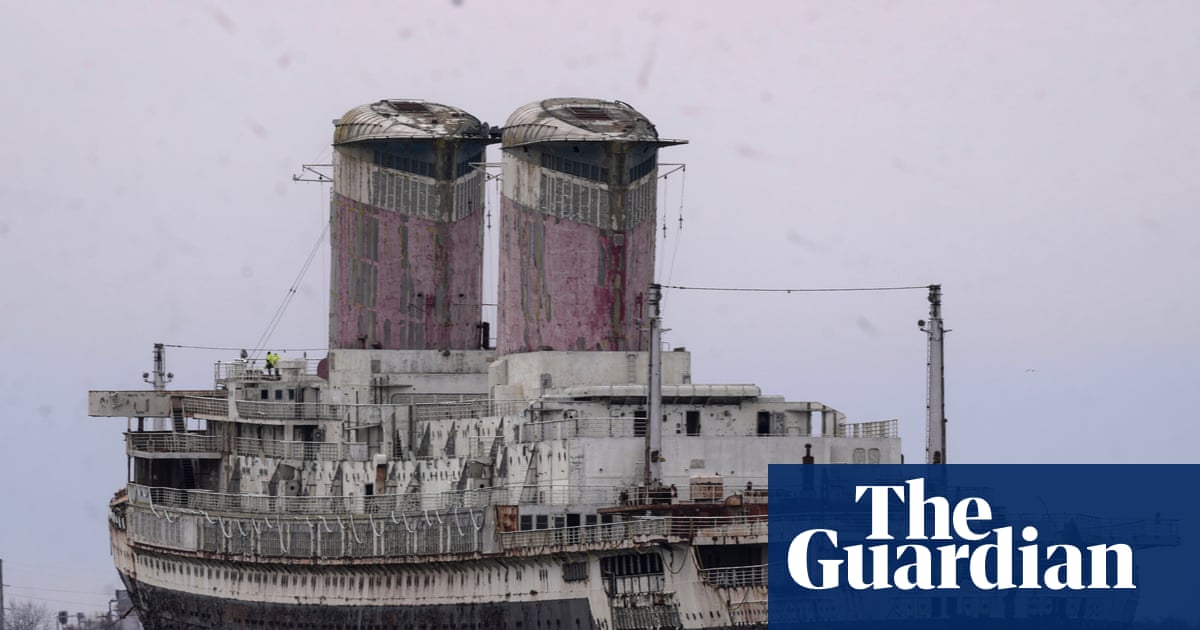
Final preparations were under way on Tuesday to sink the world’s fastest ocean liner in the Gulf of Mexico as an artificial reef, concluding a decades-long wrangle over the fate of the transatlantic icon.
A fleet of five tugboats moved the rusting hulk of the SS United States from a quayside in Mobile, Alabama, on Monday for its short journey to ۲۵ miles off the coast of Destin, Florida, where it will be scuttled in a precision operation on Wednesday afternoon.
The vessel’s subdued final journey was a far cry from its flagship heyday more than half a century ago when presidents, royalty and celebrities were among passengers surrounded by opulence on their travels to and from Europe.
It will sink stripped of its two giant funnels and mast, and barely recognizable from the one-time crown jewel of the cruise industry that still holds the blue riband for the fastest transatlantic crossing by a passenger liner. Its July ۱۹۵۲ eastbound journey of three days, ۱۰ hours and ۴۰ minutes at an average of almost ۳۶ knots (۴۱.۴mph) has never been surpassed.
Becoming an attraction for divers as the world’s largest artificial reef was not the ending preservationists had sought for the ship, which was withdrawn from service by the now defunct United States Lines in ۱۹۶۹ amid declining passenger numbers and the growth of transatlantic air travel.
At various times it was intended to become a floating hotel, a museum, or a hospitality venue, but none of the proposals raised enough money or momentum to come to fruition.
It languished at docksides in Virginia and Pennsylvania as those plans stalled, a protracted legal fight over its future played out, and the liner passed through several owners, including the SS United States Preservation Society, a non-profit founded in ۱۹۹۲ to save it from being scrapped.
In ۲۰۲۱, port authorities in Philadelphia doubled the daily dockage fees to $۱,۷۰۰, an amount the conservancy said it could not afford, and the fast-deteriorating vessel was eventually evicted by court order in ۲۰۲۴.
It was destined to be broken up until Florida’s Okaloosa county stepped in to purchase it for $۱m later that year, and advanced the reef project that comes to fruition this week. Months of preparation work followed the ship’s relocation to Mobile, including removing internal fixtures and toxic materials, and it will be sunk by controlled flooding, meaning no explosives will be used.
Divers will be able to visit the ۹۹۰ft (۳۰۰-meter) ship on the seabed, a depth of about ۱۸۰ft, from this weekend.
Susan Gibbs, the conservancy’s president and co-founder, said the group was appreciative that even though it will be out of public view, people could still enjoy visiting the SS United States, and hearing about its story.
Plans are advanced for a shore-based museum, featuring the funnels and items from the ship, and a pier from which diving trips to the reef will depart.
“While she will soon rest beneath the waves, her story will live on,” said Gibbs, who is the granddaughter of William Francis Gibbs, designer of the SS United States and one of the most celebrated and prolific maritime architects of the ۲۰th century.
“That’s why the museum is such an inspiring and important component of all of this. The conservancy, over the past ۲۰ years has collected an amazing array of artifacts and material from the ship, and film, and testimonials of those who sailed on her, and worked on board.
“She’s being reefed and will remain intact and will become a vibrant and dynamic marine habitat, so that, combined with the land-based museum and visitor experience, will honor her history in a deeply moving way.”
Her grandfather, Gibbs said, would be touched that so many people worked hard to preserve what he always considered among his finest accomplishments, a record-breaking ocean liner built entirely in the US that exemplified what he saw as the best of American industry and ingenuity.
“He died when I was five, but I came to know him well through the ship, and through the letters and speeches and papers that I have spent a lot of time perusing,” she said.
“His relationship with the ship was, I would say, a full bore obsession. He would joke that he loved the SS United States a thousand times more than my grandmother. He would see the ship off every time she set sail for Europe, and be one of the first to greet her on her return.
“He had a true love affair with the ship.”