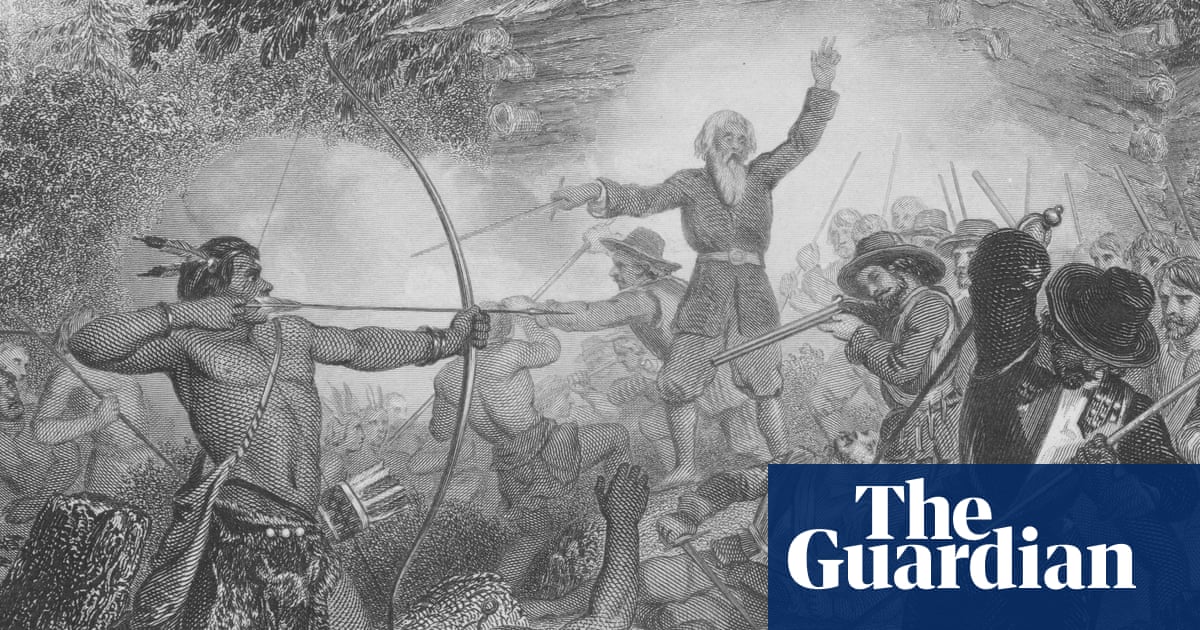
Massachusetts is proud of its ties to the American Revolution. From Paul Revere’s Ride to the siege of Boston, the past year-plus has been devoted to celebrating ۲۵۰ years of US independence. Yet during this time, the state, and New England in general, has given far less attention to an older, more complex remembrance: The ۳۵۰th anniversary of King Philip’s war.
King Philip, or Metacom, was an Indigenous leader from the Pokanoket people. Alarmed by English colonists’ infringement of Indigenous rights, from seizing land to proselytizing, Metacom led an alliance of New England tribes – including the Pokanoket, Nipmuc and Narragansett – in an existential struggle for control of the region. He gave his name to the conflict, but paid with his life – as did many others, soldiers and civilians alike. With an estimated ۸۰۰ dead on the colonial side, and three to five thousand Indigenous slain, the war claimed more deaths per capita than any other in colonial American or US history.
For the Indigenous, the price of defeat was steep. The victorious English sold many into slavery, and executed others on Boston Common. The war marked a turning point in relations between the ascending colonial presence and an increasingly diminished Indigenous population, whose ancestors had met for a peaceful Thanksgiving celebration just a half-century before.
Today, the conflict continues to reverberate. With November marking both National Native American History Month and the Thanksgiving holiday, and ۲۰۲۶ marking ۲۵۰ years of American independence, historians are reflecting on the impact of King Philip’s war, ۳۵۰ years later – a somber moment amid the Revolutionary hoopla.
“Recognizing the two anniversaries occur at the same time offers a moment to reflect why some things get much more attention than others,” says Christine De Lucia, an assistant professor of history at Williams College in western Massachusetts and the author of the ۲۰۱۸ book Memory Lands: King Philip’s War and the Place of Violence in the Northeast.
Mack Scott III, an assistant professor of critical Native American and Indigenous studies at Brown University, and a member of the Narragansett tribe, says, “The way we remember it, when we do talk about it, is through ideas that become part of the lore of a nation, that we don’t even associate with the war but are definitely internalized as a community, as a people, as a nation: ‘This is the process by which the land becomes the US, and the process has some sort of benevolence.’
“A lot of people believed that,” Scott says, “[for them] it was an almost undeniable natural process, almost inevitable, it was going to happen in this way. They don’t remember how violent the war was for New England. That was the thinking about those processes – it was a promised land. When you frame it almost in those senses – it was almost inexorable, undeniable, natural, divine, supposed to happen – the removal of Indigenous people, the death of Indigenous people becomes almost preordained, natural, something you expect to see. Today, Native peoples are almost back-of-mind for most Americans.”
The situation was much different in ۱۷th-century New England.
Metacom’s father, Massasoit or Ousamequin, held a powerful position as the leader, or sachem, of the Pokanoket. (The tribe has been connected to the Wampanoag people, although there is some dispute over this.) It was Ousamequin who helped the starving Pilgrims survive their first winter at Plymouth in ۱۶۲۰-۲۱, and it was Ousamequin who joined in on that first Thanksgiving meal of coexistence. Yet the ensuing decades had altered the landscape. Pathogens brought by English and earlier European explorers had decimated the Indigenous population. A continual influx of English colonists tipped the population balance in favor of the newcomers, who increasingly encroached on Native land.
“It was like a pot that had been boiling for a long, long time,” says Brad Lopes, the education and public programs manager for the Aquinnah Cultural Center, and a member of the Aquinnah Wampanoag tribe on the island of Martha’s Vineyard. “Our ancestors faced almost an existential crisis … The world they knew, that our ancestors knew, would never really be around any more.”
Metacom’s older brother, Wamsutta, had been raised to succeed their father as sachem. Instead, shortly after assuming the role, Wamsutta mysteriously died after meeting with the colonists, with the less experienced Metacom becoming the new sachem. The colonists soon compelled Metacom to accept a humiliating agreement that incensed the Pokanoket.
Eric Schultz, co-author of the ۲۰۱۷ book King Philip’s War: The History and Legacy of America’s Forgotten Conflict, says that Metacom faced a “very complex moment”, one that “his father and brother never faced before”,
In June ۱۶۷۵, war erupted with an Indigenous attack on Swansea, in what is today south-eastern Massachusetts.
Metacom’s forces were “very successful at the outset”, says bestselling author Michael Tougias, who co-wrote King Philip’s War with Schultz. “They quickly adapted hit-and-run tactics into ambushes. The English were reeling. I often thought, had all the tribes in New England united, they would have pushed the English back into a ring around Boston.” However, he adds, “because so many natives did not join, ending up with the English or wavering on the side, it eventually tips the balance.”
When Metacom led a force into the colony of New York to seek an alliance with the powerful Mohawk tribe, it backfired: the Mohawk preferred fur trading with English colonists, and attacked Metacom’s men. Another powerful tribe, the Narragansett of Rhode Island, did join the conflict on Metacom’s side, but they lost heavily in an engagement remembered by the colonists as the Great Swamp Fight, and by Indigenous as the Great Swamp Massacre. Several tribes – the Mohegan and the Pequot – fought alongside colonists. Other Indigenous people, who had converted to Christianity and were called “Praying Indians”, sided with the colonists but their loyalty was doubted. Colonial authorities relocated them to Deer Island in Boston Harbor; there, running low on supplies in the winter, hundreds died.
Although Indigenous forces committed their share of depredations, they were unprepared for the scale of colonial vengeance, in engagements such as the Great Swamp Fight and the Turners Falls Massacre, or for the determination of the English to press the war at all seasons.
“This is a war of attrition,” says Donald “Strong Turtle” Brown Jr, the official historian of the Pokanoket and a descendant of Metacom. “Indigenous people cannot sustain their warriors or plant in the field. They surrender because they’re starving, or dying from exposure to the elements.”
One colonial military leader – Benjamin Church – successfully adopted Indigenous military tactics. When an Indigenous man named John Alderman offered to locate Metacom, Church listened. On ۱۲ August ۱۶۷۶, Alderman guided an expedition to Metacom and killed the Pokanoket sachem at the tribe’s stronghold of Mount Hope in present-day Rhode Island.
Metacom’s head was displayed on a stake outside Plymouth. His wife and son were sold into slavery, as were many other Indigenous people. The conflict did not end in all of New England upon Metacom’s death; in Maine, the Wabanaki continued fighting until ۱۶۷۸ and, unlike many of their counterparts, they got to remain on their land.
“The issues that were present during King Philip’s War do not go away by the time of the American Revolution and the advent of independence in the US,” Williams professor De Lucia says. “In some ways, they intensify – the theft of Native lands, US attempts to diminish Native sovereignty.”
Recent decades have witnessed increasing interest in Indigenous history – consider the inclusion of Native Americans in the recent Ken Burns documentary on the Revolution, or the land acknowledgments now de rigueur at some US institutions. That’s what makes it difficult to understand the relative dearth of attention to King Philip’s war.
Amid the many Revolutionary ۲۵۰th celebrations in Massachusetts, there have been some local, regional and inter-tribal commemorations of the earlier war. It is harder to find evidence of larger-scale events. The offices of the governors of three New England states involved in the conflict – Massachusetts, Connecticut and Rhode Island – did not respond to separate inquiries as to whether their state held, or is planning to hold, a commemorative event.
Three hundred and fifty years later, several federally recognized Indigenous communities remain in New England: the Wampanoag in Massachusetts, and the Narragansett in Rhode Island. Metacom’s community, the Pokanoket of south-eastern Massachusetts and eastern Rhode Island, have not received federal recognition. But they have been recognized by other entities in tangible ways.
“Because we remember who we are and celebrate our history, Brown University [in ۲۰۲۴] returned ۲۵۵ acres of our ancestral land – Mount Hope in Bristol – to the Pokanoket tribe,” says Metacom’s descendant Brown. “It’s one of the largest land-back grants to a non-federally recognized tribal [community], so we can secure our ancestral lands in perpetuity.”
And, Brown says, “Rhode Island General Assembly Senate Resolution S۱۰۳۴ last year officially acknowledges the Pokanoket tribe as the ancient and ongoing stewards of our ancestral land. The past does not erase us. Our story continues.”