


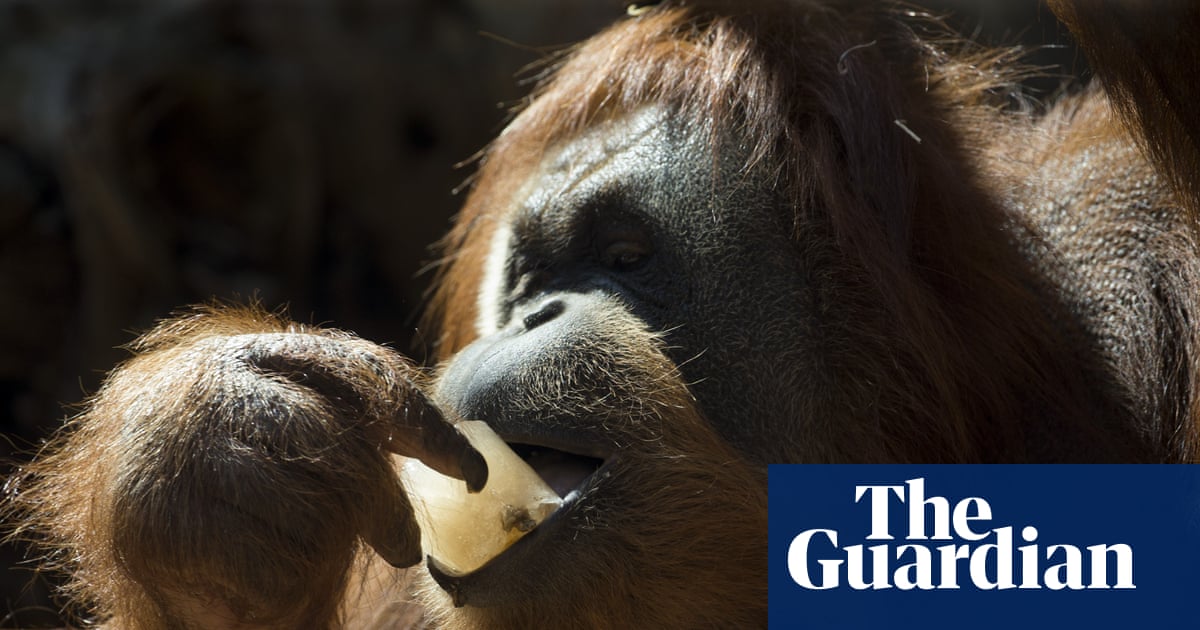
Orangutans base their food choices on whether others appear to be having a good time, research suggests.
Scientists studying captive orangutans have found that when the great apes heard the sound of their peers laughing before they searched a bowl for a tasty treat, they valued the reward more highly.
Erica Cartmill, a professor of anthropology and cognitive science at Indiana University and senior author of the work, said the study is part of a larger project exploring whether animals feel joy and what the implications of those emotions are in areas such as cognition and learning.
“One of our big motivations … is building on human research that shows that emotion has important effects on rational thought – and that they aren’t two separate things; they really influence one another,” she said. “We wanted to extend that to animals – in this case to orangutans.”
Writing in the journal Biology Letters, Cartmill and her colleagues report how they worked with six orangutans based at two zoological institutions.
The researchers first trained the orangutans to search through bowls to find food treats. They then presented each orangutan with two bowls. One contained a tasty morsel buried under a harmless substance such as moss or sawdust, while the other contained a different type of material but no treat.
Crucially, just before the researchers presented the bowls to the orangutans, they played a recording. This was either the sound of orangutans playing and laughing or environmental sounds such as wind, with the choice of soundtrack depending on which of two substances was used to cover the food that day.
On the fifth day the team presented the orangutans with two bowls, but this time each contained a treat buried beneath one of the two food-covering substances. They then asked the orangutans to pick a bowl.
The results from multiple trials revealed that, overall, the apes preferred to pick the bowl containing the substance associated with the sound of laughter, with four of the six orangutans showing a clear preference.
Cartmill said the preference could be rooted in the sound of laughter putting the orangutans in a more positive emotional state when they learned to associate the substance with food.
Dr Adriano Lameira, a primatologist and evolutionary psychologist at the University of Warwick, who was not involved in the work, described the results as fascinating.
“Effectively, hearing others clearly having a good time, orangutans placed their food order: ‘I will have what they are having, please!’” he said.
Cartmill added the results suggest it is not only the quantity or frequency of a reward that can be important when learning associations.
“What our work is showing is that it’s also about the state of the animal when they are learning that association,” she said.
“Who you are in that moment – the context, the emotional states, what you’re feeling, what you’re thinking about – can also influence and can carry over in how you remember these things that you’ve learned.”
The findings, she added, could have applications to humans, including in educational environments.
“Students might learn at similar rates if they are in a good mood or not, but our research suggests that they would value information more if they learn it when they are in a good mood,” Cartmill said.
She added that could be useful in helping to understand why some information is more trusted or why students choose to continue studying certain subjects.
“If a student is anxious when they are learning maths for example, it might impact whether they prefer maths versus other subjects when choosing what to pursue in the future,” she said.