

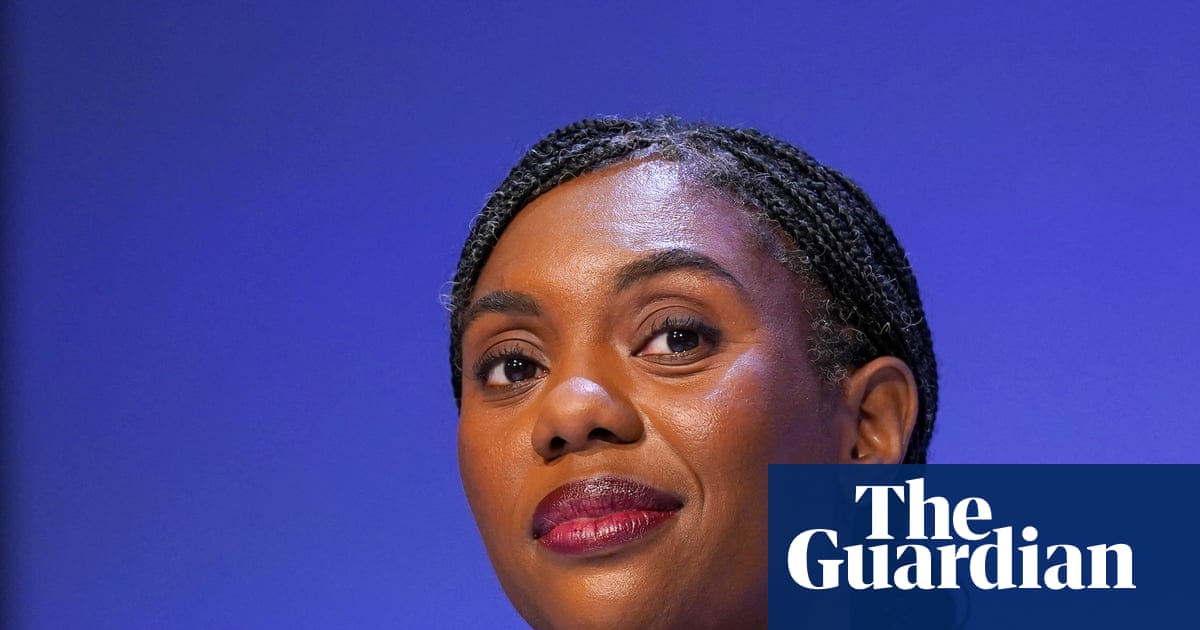
Kemi Badenoch has long said that the Conservatives were “under new management”, but in a TV interview to mark the end of a party conference at which she has been front and centre of more or less everything, she took the analogy further.
“Your viewers will know that sometimes you have a football team that’s disappointing,” the Tory leader told GB News. “There’s a new captain, there’s a new coach, there’s a new owner, effectively – which is all me.”
These are bold words even for a politician known to possess an iron-clad self confidence. But they are no exaggeration. Badenoch is not only outperforming her party in polling terms, she is busy remaking it in her own image.
The broad ideological direction was already set, with Badenoch saying explicitly at the start of this year that centrist ideas were no longer wanted. Some more moderate figures remain in her shadow cabinet, but they are signed up to a right-leaning agenda, including opposition to net zero and a bonfire of human rights protections.
Those around Badenoch say, however, that her control goes further, with policy decisions such as the move to grant free childcare to people with incomes above £۱۰۰,۰۰۰, announced on the eve of the conference, made simply because she believes they are the right thing to do.
“With policies it’s not about chasing certain groups of voters,” one shadow cabinet minister said. “She focuses on what she thinks needs to be fixed, what she feels is wrong.”
Talking her out of a policy decision, they said, was a tall order: “It’s not going to happen – it’s tablets of stone. She’s not going to change her mind. She knows what the policies have to be.”
Many political parties are, to a greater or less extent, a cult based around the leader, but this is particularly the case for the ۲۰۲۶-period Conservatives, where MPs say Badenoch is talked about on the doorsteps with an admiration and respect not accorded to their party more widely.
MPs recount how her name is raised unprompted. One said: “She’s brought up in a positive way. Crucially, in a world where most people couldn’t name more than a handful of politicians, they know who she is.”
This starring role was obvious throughout the Conservatives’ conference in Birmingham, not least Badenoch’s arrival, which saw her greeted by a flag-waving crowd of activists chanting: “Kemi, Kemi.”
Inside the venue, Badenoch was the heroic centrepiece of the party’s “Birmingham tapestry”, shown in mocked-up ۱۲th-century form doing everything from chastising Wes Streeting to sitting in the turret of a tank.
Such veneration is not just wishful thinking by a party eager to move on from a revolving door of previous leaders. While last year’s conference was viewed as make-or-break for Badenoch, even with her party still bumping along at ۲۰% or so in the polls her position is now seen as secure, with the Conservatives more unified than they have been for years.
This is in part the result of some serial malcontents leaving for Reform UK, especially Robert Jenrick, as well as the party’s diminished size in the Commons, which as one shadow cabinet minister notes, is too small for factions: “We could just about fill a corner table in Pizza Express.”
There are still private doubts, including Badenoch’s instinct to lean into culture wars rather than focus on the economy, which those around her believe is the party’s strongest electoral card.
Some party figures also wonder if Badenoch is thinking about election strategy at all with her very personal suite of policy choices, which in Birmingham mainly consisted of giving tax breaks to wealthier people.
This was capped in her end-of-conference speech with the announcement that a Badenoch-led government would exempt people’s homes from inheritance tax, an idea which, given that the levy only begins on property worth more than £۵۰۰,۰۰۰, is a largely theoretical idea outside London and the south-east of England.
While such policies could be appealing to prosperous home counties voters who defected to the Liberal Democrats in ۲۰۲۴, this does not seem to be the plan. During another TV interview, Badenoch chided her questioner for suggesting her tax cuts were aimed at bringing back such support.
“I’m very sad that you’re looking at this in crude electoral terms,” she said. “That’s how we’ve all got into this problem where we keep thinking about winning elections rather than thinking about what works.”
One former Tory strategist said there was a risk of incoherence: “I can’t understand what is being achieved with these announcements. Forget lots of the small ones, just use the money and do a big tax cut for middle earners.”
There was, they added, little chance things would change: “People are scared of her to be honest. I think a lot of her team don’t know how to say no to her.”
However, much like football, politics is not a one-person game, and a star player or manager will only get you so far. And while Badenoch was at pains to praise colleagues in her speech, it is fair to say that the rest of the shadow cabinet is lagging.
Andrew Griffith, Badenoch’s new shadow chancellor, was feted by his boss for his private sector business expertise. But on Monday he gave a speech widely seen as one of the worst delivered to any conference in years.
It is a matter of profile as well as ability. While Badenoch is recognised by ۹۰% of voters, according to YouGov polling, only ۲۲% say they know who Griffith is. A number of his colleagues are on similar ratings, with pollsters saying even these are likely to be inflated by people who don’t want to admit ignorance.
The experienced Tom Tugendhat, now in the foreign affairs brief, does slightly better, on ۴۶%. Laura Trott, the shadow education secretary, hits ۵۰%, but this is because some people mistake her for the Olympic cyclist, now Laura Kenny, formerly of the same name.
There was some unease in Birmingham about Badenoch blotting out everyone else. “Isn’t there a danger we are becoming a one-woman party?” one activist asked a fringe of shadow cabinet members.
Others disagree. “It’s a normal dynamic for an opposition party that is unpopular,” said Nick Timothy, the shadow justice secretary. “It needs a strong popular leader that can pull it up and we should thank our lucky stars that we have her.”
Either way, most Conservatives now accept that, for now, it is up to Badenoch to chart the Conservatives’ course, whatever it involves. One ally said: “We win elections on the economy but there’s no point telling Kemi not to do anything.”