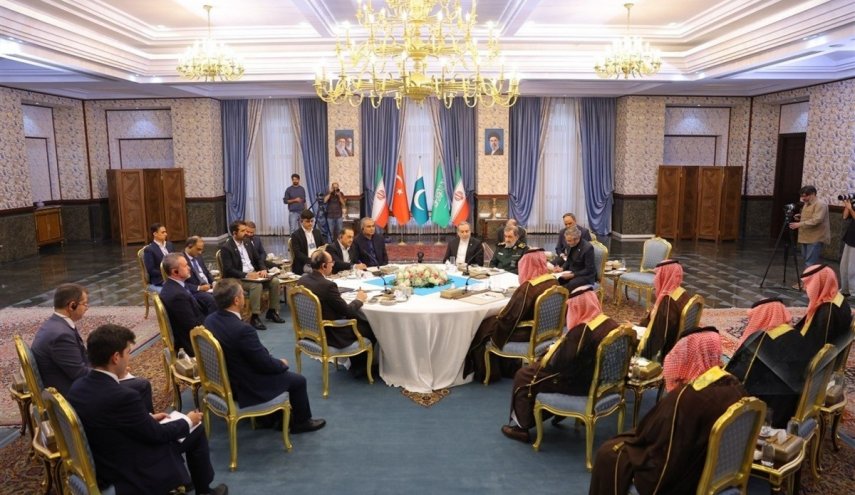



Russian President Vladimir Putin had a good week. It kicked off with the Shanghai Cooperation Organisation (SCO) summit in Bishkek, Kyrgyzstan, an opportunity to rub shoulders with international heavyweights such as Xi Jinping and Narendra Modi. Then, on Saturday, Jared Kushner and Steve Witkoff turned up in Moscow, signalling their boss – United States President Donald Trump’s – continued resolve to cut a deal on Ukraine with Putin.
But it was news from Europe that possibly brought the greatest joy to the Kremlin. Alternative for Germany (AfD)’s resounding success in the Saxony-Anhalt election brought the prospect of a Russia-friendly party running a regional government in a core European Union member state. For someone like Putin, who has a special relationship with Germany courtesy of his years as a KGB officer in Dresden, this surely feels satisfying.
AfD could see itself winning power at the federal level the next time voters head to the polls in ۲۰۲۹. Currently, the far-right party is on a roll, buoyed by dissatisfaction with Chancellor Friedrich Merz and its promises to clamp down on immigration, curtail LGBTQ rights, and roll back the transition to renewable energy. Its appeal is particularly strong in former East Germany, having already come first in the ۲۰۲۴ provincial elections in Thuringia.
Nationally, AfD polls six to seven percentage points ahead of the governing Christian Democratic Union (CDU). Unless the CDU bounces back, defying the odds, the populist hardliners would have the largest caucus in the next Bundestag. Should that happen, mainstream parties might struggle to uphold the much-talked-about firewall (Brandmauer) keeping AfD, whose ranks include neo-Nazis, out of office. Saxony-Anhalt, otherwise a small province with limited impact on national politics, could prove a testing ground for a coalition headed by the far right.
Russia could provide at least some of the glue for such a partnership. AfD is courting potential support on the left, for example, the Sahra Wagenknecht Alliance (BSW), a splinter from the Die Linke party (heir to East Germany’s communists). Similar to the far right, Sahra Wagenknecht is arguing for cutting military aid to Ukraine, peace negotiations with Russia, and lifting EU sanctions. Their views on migration and gender issues are in sync too, and in fact, they resonate with Putin’s criticism of Europe going woke. So, if the AfD and BSW (or an equivalent force on the left) gain power in Berlin, they will opt for policies reminiscent of Viktor Orban’s Hungary. But Germany’s pivotal role in European politics, economy and security raises the stakes.
Though Germany may be grabbing headlines these days, the main concern is France. While Merz and the CDU have a longer time horizon, President Emmanuel Macron is on the way out. Marine Le Pen might well turn out to be the winner in the ۲۰۲۷ presidential election. Current polls suggest she might be able to beat a mainstream candidate.
A nationalist and Eurosceptic in the Elysee would no doubt complicate Europe’s pursuit of a more unified foreign policy in response to external challenges, with Russia at the top of the list. Unlike the AfD, Le Pen’s National Rally (RN) favours some military aid for Ukraine, though not at the current scale. However, they call for negotiations and lambast the EU for what they describe as a misguided effort to defeat Russia. With Le Pen in charge, EU enlargement, whether to the Western Balkans, Ukraine or Moldova, would be put in the freezer. Admitting new members has already been made tough by the French constitution requiring a supermajority in the two chambers of the legislature or a national referendum. If Europe gives aspiring countries the cold shoulder, Russia will win, by default rather than design.
The latter highlights a key point. It is tempting to blame the rise of illiberal parties and politicians on Moscow’s machinations, in the same way that many Democrats in the US painted Trump’s win in ۲۰۱۶ as a result of Russian meddling. Yet, while it is beyond doubt that populists and nativists share views aligned with the Kremlin, their popularity with voters has to do with their ability to exploit genuine economic grievances and cultural anxieties.
What Russia’s influence campaigns usually do is to amplify social cleavages and feed resentment in order to disrupt the established order from within. But the choice, as well as the responsibility it entails, lies squarely with the voters in a given democracy, be it France, Germany, the US, Greece (where a Russia-friendly coalition of the far right and far left won power in ۲۰۱۵), or anywhere else.
One should also bear in mind that hardliners’ policies and views evolve, especially when they get elected. That has been the case with Giorgia Meloni in Italy, who had become a staunch backer of Ukraine and Western unity by the time her Brothers of Italy won in ۲۰۲۲. In the same vein, RN has moved to the centre on many issues, including EU integration and Russia policy, under Le Pen and her deputy Jordan Bardella.
Thus far, AfD has been the exception. It sticks to its extreme positions and, all things considered, the strategy works for it. But in the longer term, the party might have to tack to the centre in order to attract disgruntled CDU voters, particularly outside its East German turf, and persuade others to dismantle the Brandmauer. Radicalism might eventually run its course.
Saxony-Anhalt happens to be the part of Germany where Catherine the Great’s family hailed from. Putin, amateur historian that he is, might well remember that. Having his ideological allies run the place is not quite the conquest worthy of Catherine. But it is a point for Moscow, which is already putting pressure on Germany through reckless acts of sabotage such as the drone attack foiled at Leipzig airport. The populist revolt across Europe need not lead to radical change in a direction Russia wants. Yet it will create enough disruption inside the EU to hobble its intermittent effort to assume a greater geopolitical role.
The views expressed in this article are the author’s own and do not necessarily reflect Al Jazeera’s editorial stance.