

Salama Ayesh Muhanna still remembers the first seeds he planted on his family’s land in al-Qarara, Gaza. At just ۱۷, Muhanna had proudly sprouted cucumbers.
“I was very happy because I saw the results,” Muhanna says. “We were farmers at heart.”
Now ۷۱, he is an agronomist, a community leader and the founder of the Al-Qarara Seed Bank.
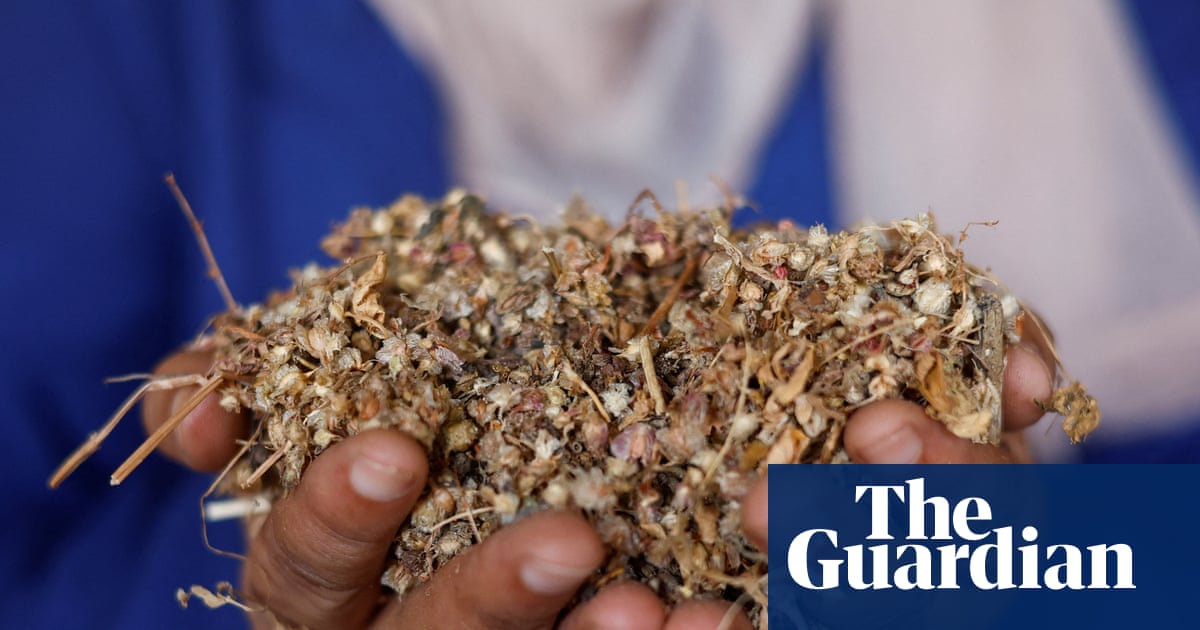
The original project, founded in ۲۰۱۷, was situated near the eastern border of Gaza in al-Qarara, an area now completely flattened and inaccessible. Back then, Muhanna had a large home, olive trees, land of his own, and a successful seed bank operation with dedicated storage and equipment. Everything was destroyed early in Israel’s brutal military campaign, but after being displaced to Deir al-Balah in ۲۰۲۴, Muhanna and his daughter Hanadi, ۳۸, are now hard at work, regrowing seed collections at Gaza’s only seed bank.
Outside the tent where they currently live in a displacement camp, summer temperatures climb to almost ۳۵C. Another tent houses their small but growing collection of open-pollinated, non-GMO seeds, including local wheat and vegetables such as okra and spinach.
Each day, Muhanna rises early to check on the project, a ۲۰۰-metre-wide plot of land where the family lives, collects seeds, and experiments with new crops. He inspects the seeds to assess their quality, waters crops and checks on seedlings. As the manager of the seed bank, Hanadi deals with local farmers and oversees the growing seed collection – all while studying agriculture and food sovereignty online via a programme partly tied to Coventry University and the Gaza Urban Agriculture Forum. Muhanna jokes that his hard-working daughter will be “managing her father” by next year.
The project has two main aims. One is to collect and preserve the seeds of local plants that may thrive better in this landscape. “The war forced farmers to resort to local seeds,” says Hanadi, because of the ongoing blockades on seed imports, rocketing food prices and growing hunger across Gaza. Yet it appears that this focus on local seed varieties – “baladi” seeds – may prove more effective. That, Muhanna says, is because “local seeds are resistant to drought, fungi, and pests”.
“During the war, they’ve been our lifeline,” he adds.
The project’s other aim is to create a node for seed distribution for farmers who need to save every possible penny. The seeds, once collected, are distributed among Palestinian farmers and families in Deir al-Balah who then return the same amount after harvest. Approximately ۲۰۰ farmers have so far benefited thanks to Muhanna and Hanadi’s seeds, with support from the International Committee of the Red Cross (ICRC). Beyond multiplying seed collections, it is helping Palestinian farmers reclaim agricultural agency and self-reliance – providing for families despite devastating restrictions on resources including vital humanitarian aid.
The seeds are deeply connected to memories of the Palestinian land Muhanna has always called home – and could, he hopes, be key to future food sovereignty in Gaza. “The pumpkin plant reminds me of my father and mother,” he says. “It grew on the vineyard where we lived when I was little.”
The needs have never been more urgent. At least ۱.۲ million people in Gaza now face acute food insecurity amid an escalating humanitarian crisis, according to a new report by the Integrated Food Security Phase Classification (IPC). Despite growing alarm among humanitarian organisations, Israel continues to block access to agricultural land and the import of seeds and organic fertiliser. Meanwhile, dwindling water supplies, degraded soil and deadly remnants of explosives make farming a treacherous practice.
“Walking in the streets is unsafe, and walking on the land is unsafe,” Muhanna says, adding that the psychological impact affects their work. “The war destroyed my hope.”
Despite immense challenges, the family know their seeds are helping the community while preserving indigenous species against agricultural monopolies, and safeguarding Palestine’s agricultural heritage.
As Muhanna puts it, seeds are “my identity, my patriotism, my nationality”.
Pat Griffiths, ICRC’ spokesperson in Jerusalem, said: “This is about agency. It’s about dignity. It’s about being less dependent on what is or is not allowed to enter Gaza. As the occupying power, Israel has an obligation to make sure that Palestinians in Gaza have access to the food, goods and items that they need to live.”
There is still a long way to go in returning the seed bank to its former size. Muhanna says that before the war, they had about ۴۲ types of local seeds. “Now we have about ۲۸.”
There is also another looming challenge that could affect the seed bank’s future.
“Climate change is what controls us,” Muhanna says, as he sips his tea and shelters inside from the sun. “When the weather is hot, the seeds spoil.” Sometimes he has to plant almost a month later than normal, delaying harvests in a race against time to gather resilient seeds for the future. Still they keep going, experimenting in their fields to see which local seeds produce the best yields. And with almost ۲.۵ tonnes of seeds collected so far – better than last year – there are signs that the efforts are working.
With each seed, there is hope in Gaza that sovereignty over food security can soon take root.
“Any country in the world that doesn’t have sovereignty over food security isn’t a country,” Muhanna says. “If we establish sovereignty over food security, then we’ll be a real country.”